✴ The Settlemint Handbook · ModulesHB_04
Governance and Dispute Resolution
Governance is how a people repeatedly make, execute, review, and correct legitimate decisions together — and a Settlemint stands it up by making decision rights, obligations, and accountability clear enough to practice repeatedly.
Governance is how a people repeatedly make, execute, review, and correct legitimate decisions together.
Governance is one of the functions a Settlemint must prove. There is a real way to make decisions, establish authority, resolve disputes, correct bad leadership, and maintain order — or there is not. A token, a DAO, a constitution document, or a voting app does not by itself satisfy this.
Governance includes:
- authority,
- decision-making,
- execution,
- accountability,
- representation,
- succession,
- resource allocation,
- dispute resolution,
- correction of bad leadership,
- and protection of legitimate boundaries.
Voting is one tool. Governance is much larger.
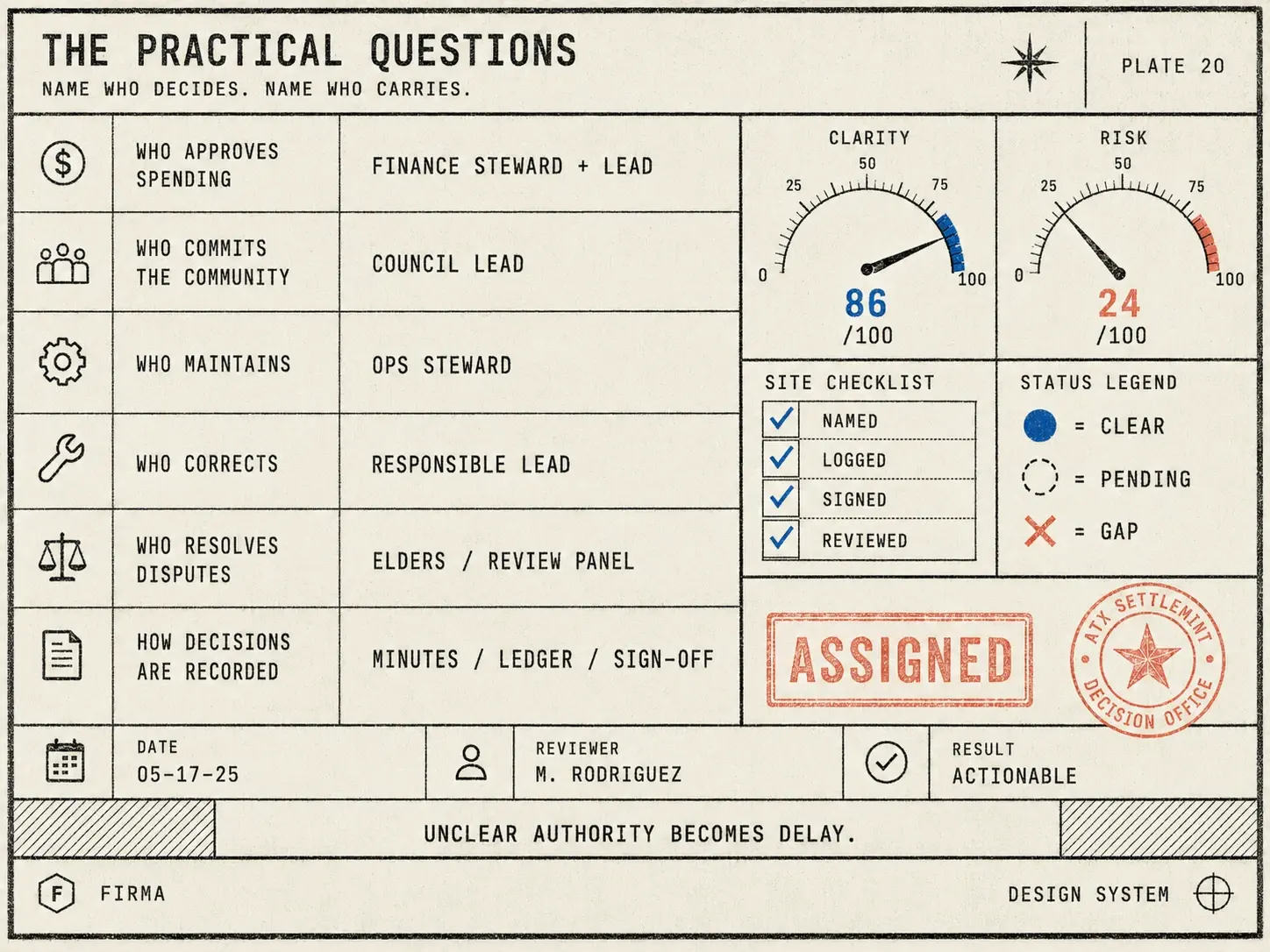
Start with the practical questions
A Settlemint should not simulate statehood or use sophisticated governance language before basic operating authority is clear.
Governance begins when decision rights, obligations, and accountability become clear enough to practice repeatedly.
The first governance questions are practical:
- Who is responsible for which domain?
- Who can approve spending?
- Who can commit the community?
- How are work priorities selected?
- How are decisions recorded?
- How are disagreements resolved?
- How is poor leadership corrected?
- Which decisions belong to owners, leadership, operators, residents, or partners?
A Settlemint that can answer these questions clearly and practice the answers repeatedly has begun governing. A Settlemint that cannot has leadership and relationships but not yet governance. The worked application of these questions to a real place is documented in ATX: A Settlemint in Formation.
Legitimacy
A system is not legitimate merely because its rules are recorded on-chain or approved by a founder.
Legitimacy asks why affected people accept the right of an authority to decide.
Possible sources include:
- consent,
- covenant,
- law,
- tradition,
- representation,
- performance,
- office,
- ownership,
- or recognized spiritual authority.
These sources can conflict. A Settlemint should name those conflicts rather than hide them. Where authority rests on more than one source — for example, ownership and covenant, or office and performance — the community should name those conflicts rather than hide them — one way is to say which source governs which kind of decision, and what happens when they point in different directions.
How spiritual authority and civil authority relate without being confused is an open question each Settlemint must answer for itself; no settled doctrine resolves it in advance.
Subsidiarity: where each decision belongs
The allocation rule across the architecture of place is:
Make each decision at the smallest level capable of handling it well.
This means:
- personal matters remain personal,
- Realm matters remain with the Realm or household,
- Settlemint matters remain local when possible,
- District matters are handled by the District,
- Nation-level matters go to the Nation,
- and Constellation matters are limited to genuinely shared concerns.
Subsidiarity is not automatic decentralization. Some problems require wider coordination. The test is capability, impact, legitimacy, and accountability.
The categories themselves — Realm, Settlemint, District, network state — are defined in Realm, Settlemint, District, and Constellation. The distinction that matters most for governance:
A Settlemint asks: Can this place sustain a people?
A District asks: Can this city-polity govern meaningful parts of its common life?
The District preserves local political life. The network state preserves the larger peoplehood and political whole.
The working tension for the District — and instructive for any local polity — is:
Strong enough to govern locally. Connected enough to belong to something larger.
Which decisions belong to household, Settlemint, District, Nation, or Constellation remains an open question. A Settlemint should apply the subsidiarity test to its own real decisions rather than waiting for a finished constitutional map.
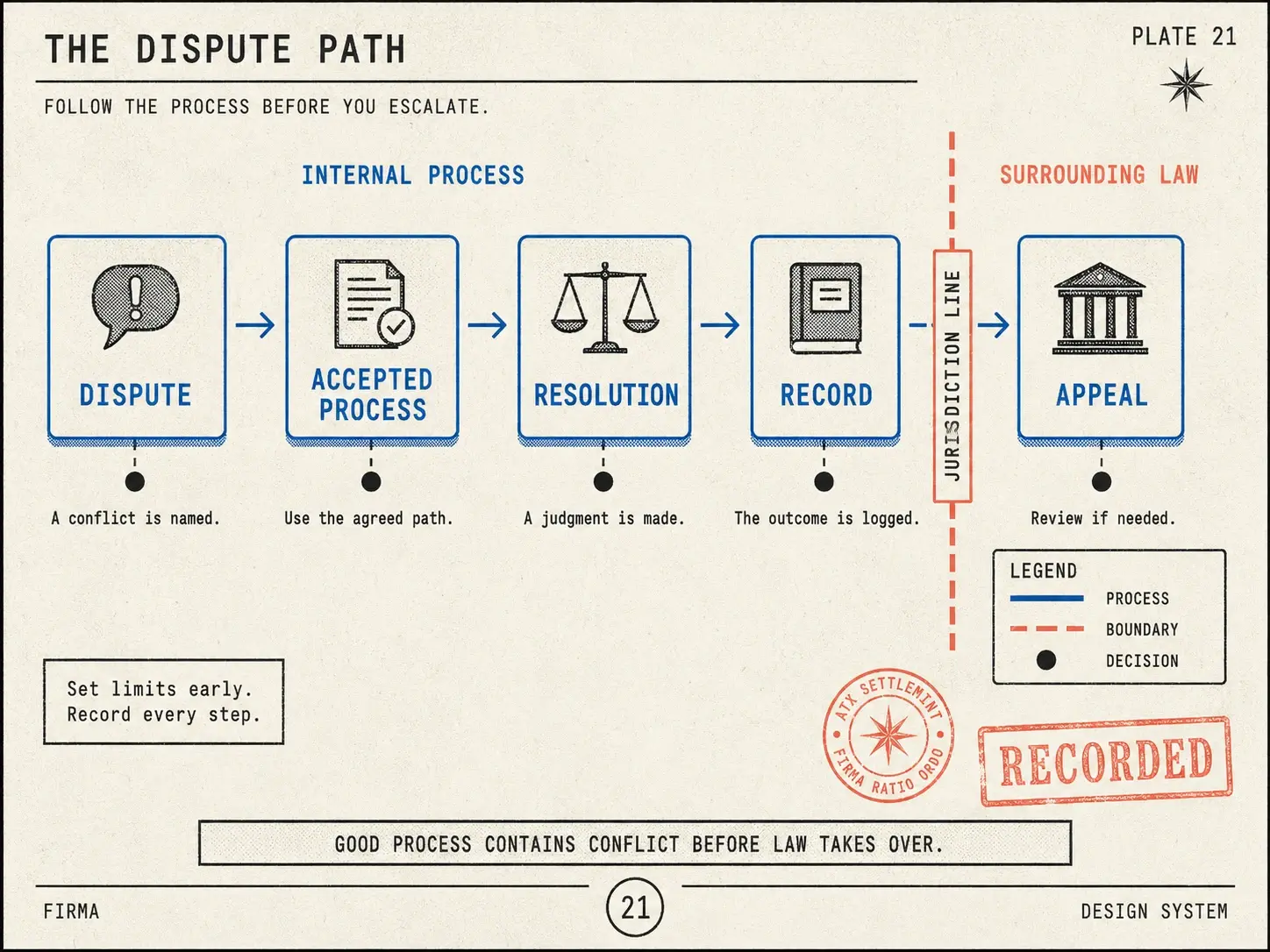
Dispute resolution is a required function
Dispute resolution is not an optional refinement. It appears in the governance proof itself: a real way to resolve disputes is part of what makes a settlement's governance real. Land does not prove that conflict can be resolved. Neither does software.
A Settlemint needs a clear answer to:
Who may live here, use shared systems, participate in decisions, receive care, carry obligations, and remain through conflict?
The last clause matters most here. A community that can only function while everyone agrees has not yet proven governance. Entry, discipline, removal, appeal, and exit remain open questions each Settlemint must answer; the handbook does not prescribe a single procedure. What it does require is a clear answer the Settlemint actually practices. Recording it, making it known to members, and agreeing on it before conflict arrives is how the memory function serves dispute resolution.
Two boundaries constrain every local dispute system:
- A Settlemint may operate its own dispute resolution for defined common matters while remaining under the laws and jurisdiction of the surrounding country. Operational autonomy is not legal sovereignty; see Sovereignty.
- Local dispute resolution should not absorb what belongs to other layers. Personal and household matters remain with the person and the Realm; genuinely political disputes may belong to a District or Nation where those exist.
Trust and legible institutions
Good governance makes authority, expectations, accountability, and correction clear enough that trust can grow.
Rules are not evidence of failed trust. Durable communities need both trust and legible institutions. A Settlemint that avoids writing anything down "because we trust each other" is not preserving trust; it is deferring the moment when unclear authority, unspoken expectations, and uncorrectable leadership consume it.
Legibility in practice means the community can remember what has happened: who decided, what was decided, what was spent, what obligations exist, and what was resolved. Governance records are part of a Settlemint's memory function, and technology should serve that function rather than replace it.
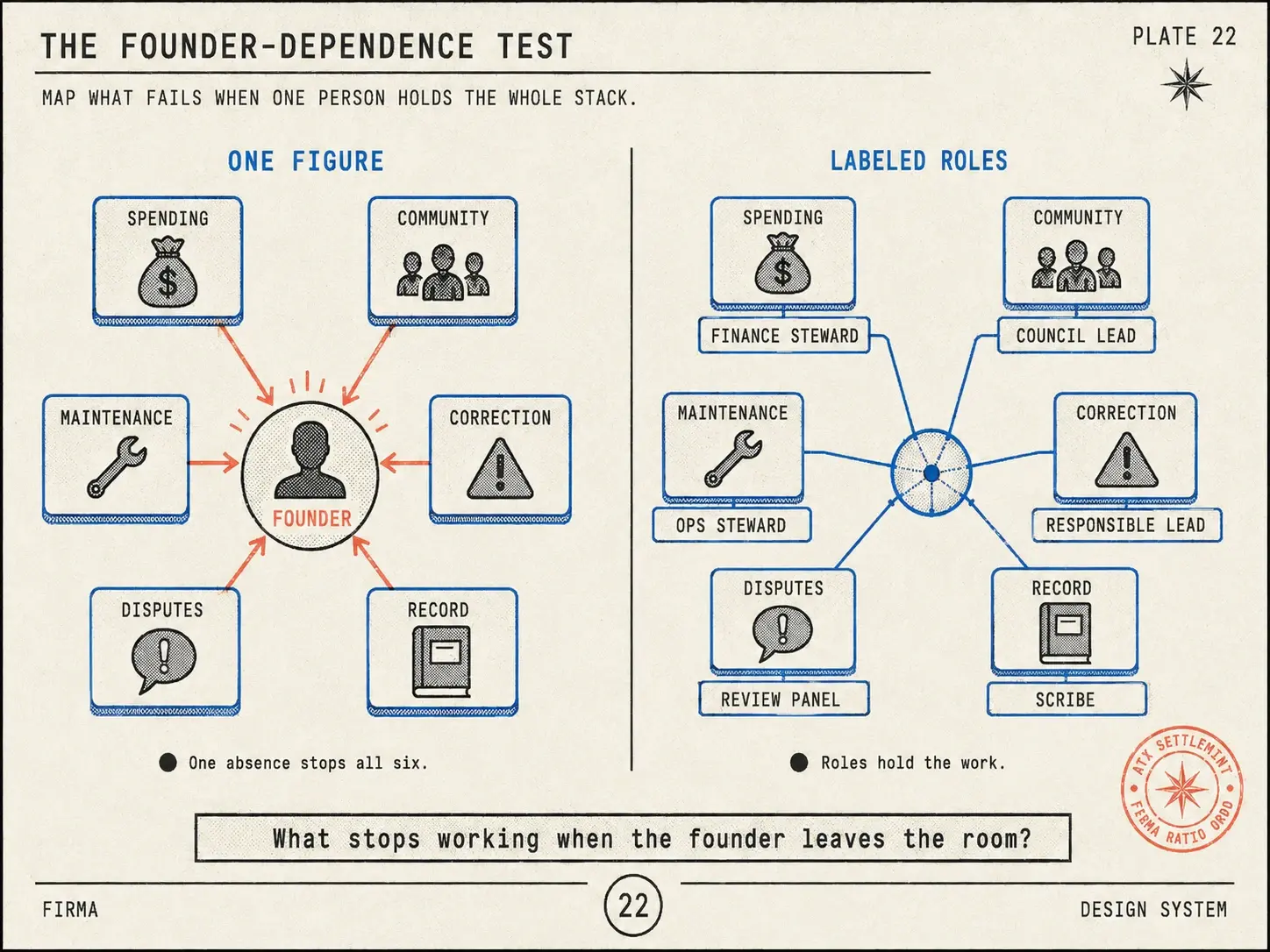
The founder-dependence test
Founders naturally carry disproportionate responsibility during formation.
But:
If every meaningful function stops when the founder leaves, the institution is not yet mature.
The goal is not to erase founders. It is to build legitimate roles, shared knowledge, succession, and durable capacity beyond one person.
Applied as a test, ask of each governance function — decisions, spending approval, dispute resolution, correction of leadership, records: does this function continue if the founder is absent? Where the answer is no, that function is a claim, not yet an institution.
What each Settlemint must still answer
The following are open questions, not settled doctrine. A Settlemint standing up governance must answer them for itself, and should record its answers as provisional:
- Membership categories and the rights attached to each.
- Which decisions belong to household, Settlemint, District, Nation, or Constellation.
- Representation — within the Settlemint and toward any larger polity.
- Entry, discipline, removal, appeal, and exit.
- Rights and duties at every layer.
- How spiritual authority and civil authority relate without being confused.
- Where a District exists: the division of powers between District and Nation, how conflicts between layers are resolved, and what makes a District legitimate.
Related modules
- The Settlemint Stack — governance as one function among the functions a settlement must integrate.
- Membership and Belonging — who belongs and who decides; belonging comes before administration.
- Maturity Stages and Proof Tests — how governance claims graduate from claim to institution.
✴ Last updated · Tue Jul 21 2026 00:00:00 GMT+0000 (Coordinated Universal Time)