✴ The Settlemint Handbook · ModulesHB_06
Work, Economy, and Treasury
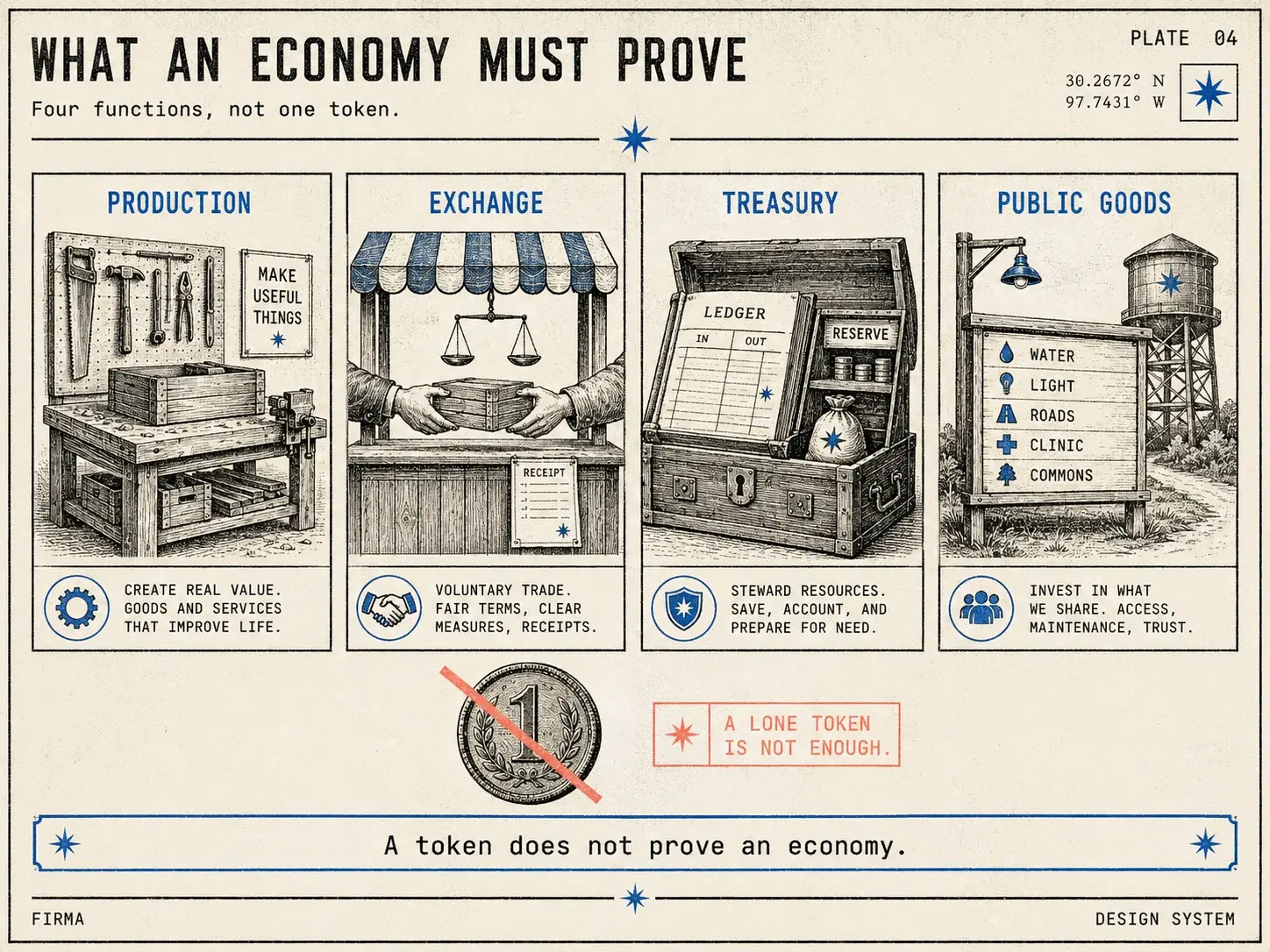
A settlement's economy is real coordination of labor, capital, exchange, contribution, production, treasury activity, and public goods — a token does not prove an economy, and only repeated productive function can prove that it endures.
A token does not prove an economy.
Economy is one of the functions a Settlemint must prove. The published proof set states the function plainly:
There is actual coordination of labor, capital, exchange, contribution, production, treasury activity, or public goods. A token alone does not satisfy this requirement.
The economy is not the settlement's currency, its treasury software, or its financial branding. It is whether that coordination actually occurs — whether real work is organized, real value is exchanged, real resources are allocated, and real public goods are funded and maintained.
The Settlemint Stack places economy and work among the eight domains every Settlemint must coordinate. This module is the operational treatment: what the function must prove, how value should move, and what treasury discipline requires.
What an economy must prove
Economic claims are subject to the same proof discipline as every other function. See Proof of Function.
Avoid saying:
We have our own economy.
when the evidence is only that members completed a limited amount of internal exchange.
Specific proof is stronger than grand language.
The published record of what a Settlemint in formation must prove names what the economic domain must still demonstrate even when capital, work, and activity already exist: repeatable productive loops, transparent treasury practices, and operating sustainability. Capital arriving is a signal. Work happening once is evidence. An economy is proved by repetition — productive loops that complete, repeat, and can be depended on.
Subsidy deserves particular honesty. Early settlements are often subsidized by founders, benefactors, or grants, and that is not failure. The failure is concealing it:
Subsidy can begin a system. Only repeated productive function can prove that it endures.
Failure is evidence too. If an economy works only while heavily subsidized, that is a material fact and belongs in the record. A durable Settlemint cannot depend indefinitely on unstructured generosity or one benefactor's liquidity.
Payment is not generosity, and generosity is not a wage
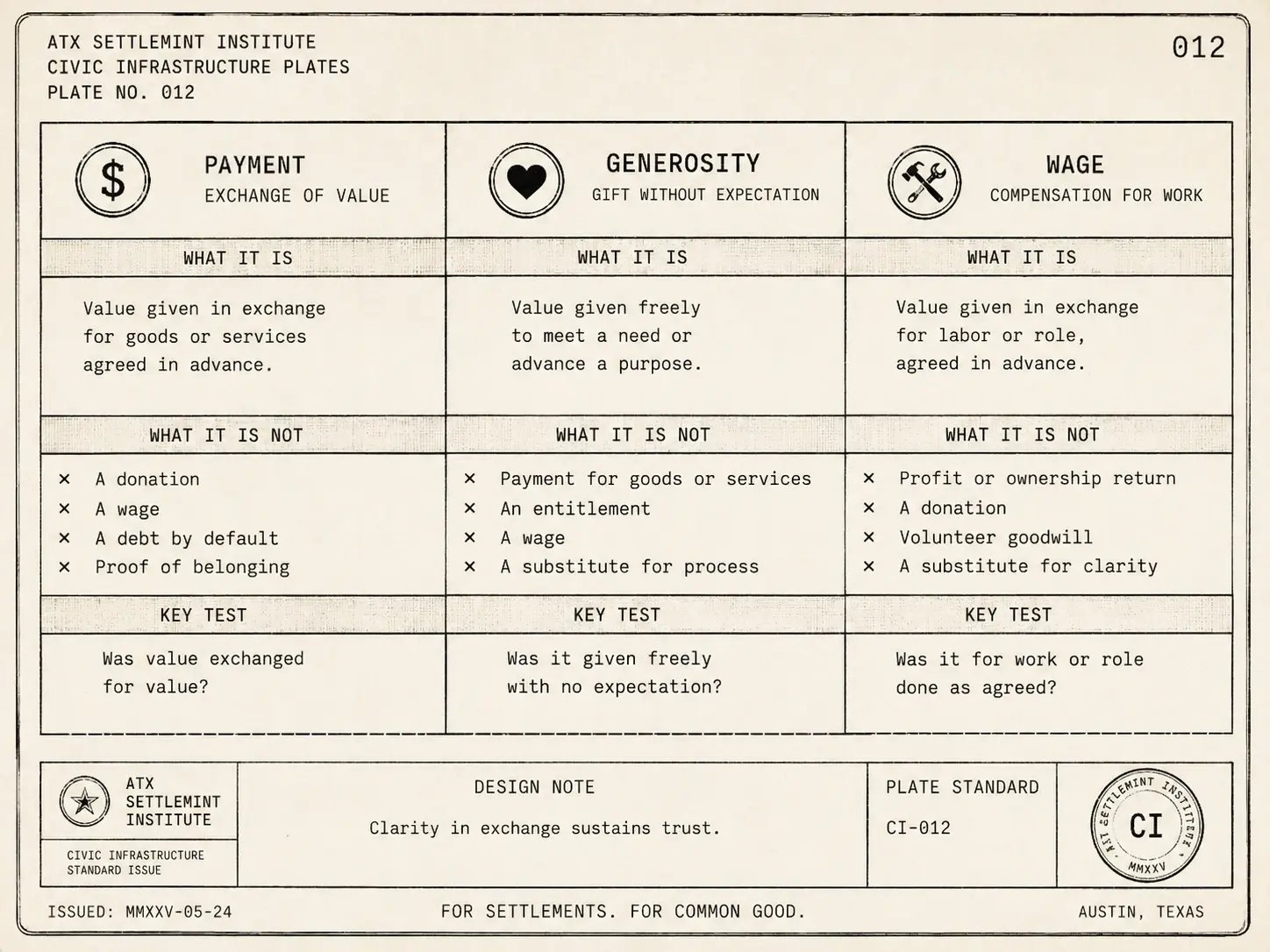
When value moves inside a settlement, it may move in different ways. Do not blur them.
Payment and compensation may take the form of:
- compensation,
- reimbursement,
- grant,
- bounty,
- stipend,
- or gift.
And separately: freely given excess — contribution beyond obligation or agreed scope.
The distinction is doctrine from the Proto-Settlemint loop, where the earn/give step keeps the two records apart:
Payment is recorded when appropriate — and freely given excess is recorded separately, because generosity is not a wage.
Both directions of confusion damage the settlement:
The system must not treat every act of generosity as unpaid labor that should have been compensated, nor every paid act as less meaningful because money was involved.
Clarity matters. Operationally: when work is completed and verified, record which kind of value moved. If someone was paid for approved work, record the payment. If someone contributed time, materials, or expertise freely beyond the agreed scope, record that separately as excess. A settlement economy should actively resist turning generosity into coerced free labor — and should let generosity become visible without becoming coercive.
Useful excess and the commons
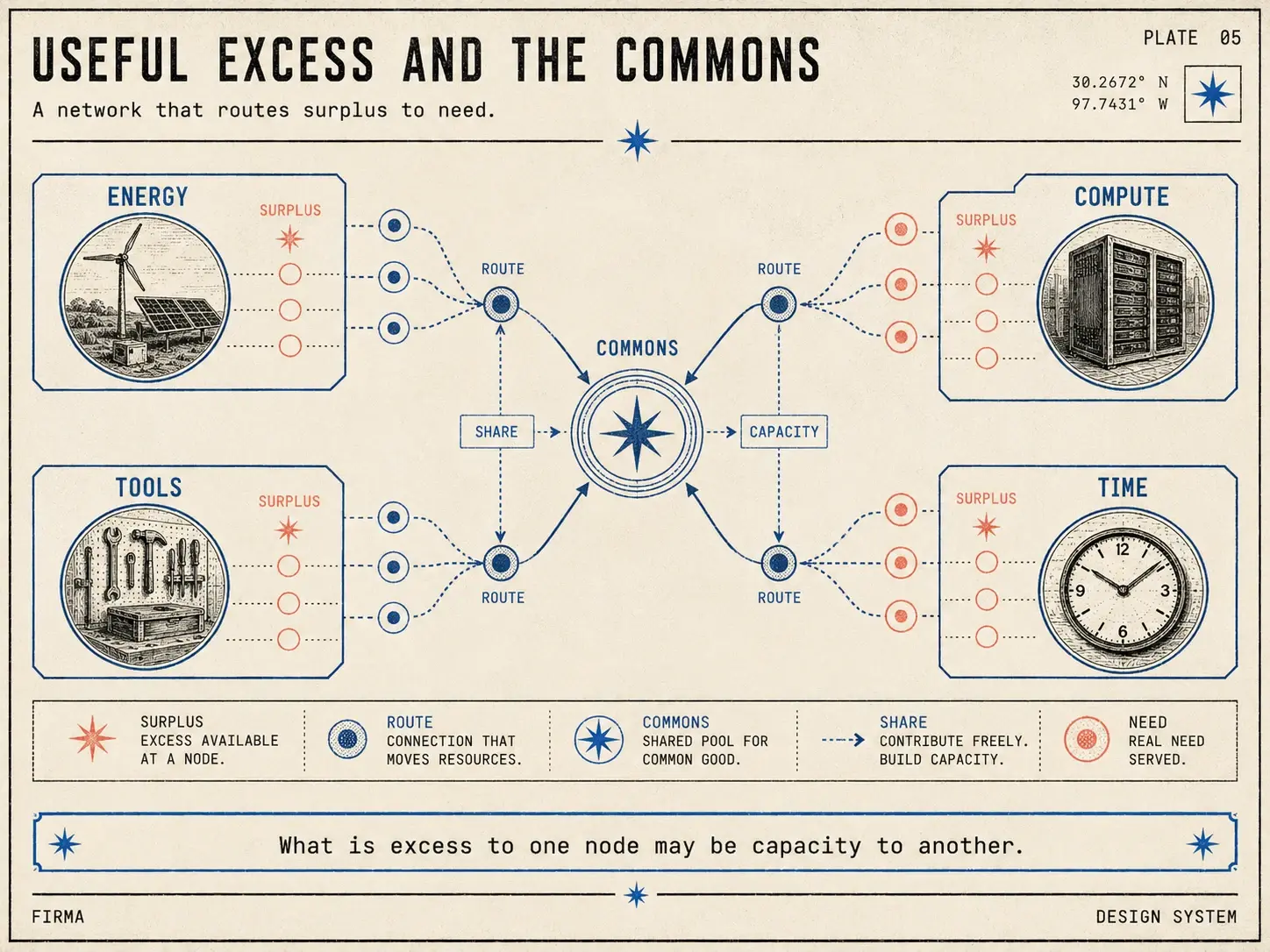
Settlements and their members produce excess that is often wasted, stranded, or difficult to coordinate: unused compute, excess energy, idle connectivity, spare physical capacity, underused equipment, knowledge, time, capital, logistics, or local production.
What is excess to one node may be capacity to another.
The real challenge is to make contribution measurable, trustworthy, routable, reciprocal, and worth sustaining. This principle belongs to the published edges doctrine — see Building for the Edges.
The phrase generosity is the consensus mechanism describes a social and economic thesis, not a replacement for technical consensus protocols:
A durable commonwealth can emerge when people repeatedly contribute useful capacity beyond immediate self-interest and the system makes that contribution generative rather than merely consumptive.
But generosity cannot be coerced without becoming extraction. A serious settlement economy must answer:
- How is contribution recognized?
- How are contributors protected?
- How are free riders handled?
- How is the commons governed?
- When should contribution create compensation, ownership, reputation, reciprocity, or no return?
A commons is not simply something free. It is a shared capability governed through rules, stewardship, maintenance, and legitimate access.
A commons without stewardship becomes depletion. A commons without meaningful access becomes private infrastructure with better language.
Earning by giving excess is an unproven thesis
Earning by giving excess points toward a possible economic pattern: a Realm, household, or Settlemint may contribute compute, energy, connectivity, storage, hosting, logistics, physical infrastructure, or another productive resource to a wider network, and may receive value in return.
The published constraint on this pattern:
The network should create value by making previously isolated capacity useful — not merely by financializing participation.
Any future mechanism must prove:
- the resource is real,
- the contribution is useful,
- demand exists,
- accounting is credible,
- compensation is sustainable,
- and the economics are not primarily speculative.
Until then, this remains a thesis rather than a proven model.
Treasury discipline
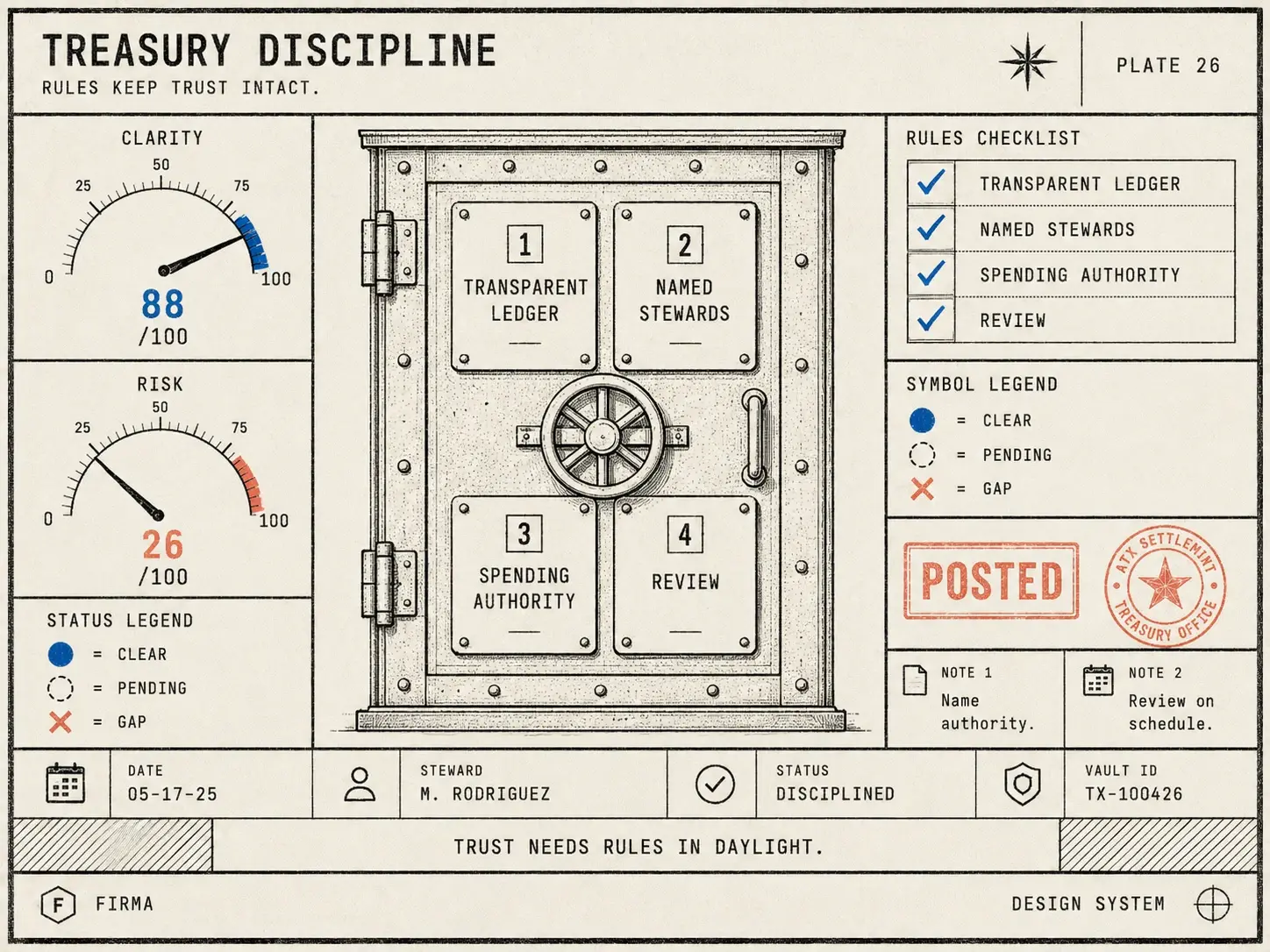
A Settlemint standing up its economy should develop real productive activity, transparent resource flows, work systems, treasury practices, and repeatable economic loops. A settlement economy is succeeding when resources are being stewarded transparently — when the community can see what came in, what was spent, who approved it, and what obligations remain.
Treasury practice connects three other required functions:
- Governance — who can approve spending and who can commit the community are among the first practical governance questions; see Governance and Dispute Resolution.
- Memory — the settlement must remember what was decided, what was spent, and what obligations exist.
- Proof — a treasury funding real public goods is evidence; an operating treasury by itself is only a signal.
Technology serves the treasury function; it does not constitute it. The published reference implementation lists provisional technical components for this — task coordination, reputation and contribution history, transparent treasury operations, and USDC-based payments where appropriate — with the standing rule:
The human function is canonical. The technical implementation is provisional.
A Settlemint should use the simplest reliable tool that solves the present problem.
Revenue is not the purpose. Durability is necessary.
The published doctrine for the first Settlemint in formation states the rule:
Revenue is not the purpose of ATX. Economic durability is necessary if the place is to continue serving its purpose.
The same holds for any Settlemint. Productive functions exist to serve the settlement's mission and sustain its operation — not the reverse. A settlement that never develops repeatable productive function will not endure.
The worked application of this whole module to a real place — its economic evidence, what remains unproved, and its provisional technology — is documented in ATX: A Settlemint in Formation.
Related modules
- The Settlemint Stack — economy and work as one of the eight domains a settlement must integrate.
- Starting a Settlemint — standing up the first economic loops alongside the other first systems.
- Governance and Dispute Resolution — spending authority, accountability, and correction; treasury discipline is a governance practice.
✴ Last updated · Wed Jul 22 2026 00:00:00 GMT+0000 (Coordinated Universal Time)