✴ Appendix53 terms
Glossary
The guide's working vocabulary, gathered in one place. Definitions are quoted from the chapter where each term is established, or from the canon glossary and the Firma organizational architecture — follow the reference to read it in context.
A
- ATX
- ATX is a genesis Settlemint in formation in Austin, Texas — a real place where the framework must prove itself through lived human function.
- → CH_10 · ATX: A Settlemint in Formation
- Audience
- An audience pays attention. The relationship is mainly between the audience and a central voice, brand, or platform.
- → CH_06 · From Community to Network State
- Authority
- Authority is the recognized right to make decisions, issue rules, or direct action.
- → CH_03 · What Is Sovereignty?
- Authority and Autonomy Profile
- A ten-question profile — capacity, control, authority, jurisdiction, dependence, recognition, legitimacy, continuity, exit and appeal, ultimate authority — that shows the real shape of authority and dependence rather than one slogan.
- → CH_03 · What Is Sovereignty?
- Autonomy
- Autonomy is the ability to govern or operate within a limited domain while remaining subject to a higher authority.
- → CH_03 · What Is Sovereignty?
C
- Claim
- A statement about what something is, intends to become, or believes itself to be. A claim may be sincere and important. It is not yet proof.
- → CH_05 · Claim Is Not Proof
- Collective action
- The proven ability of people to decide and act together toward a shared outcome.
- → Final Glossary — canon draft
- Community
- A community forms recurring relationships. Members interact with one another, not only with the founder.
- → CH_06 · From Community to Network State
- Constellation
- A Constellation is a voluntary higher-order network of distinct polities that remain politically themselves while coordinating selected capabilities, infrastructure, standards, and reciprocal commitments.
- → CH_07 · Realm, Settlemint, District, and Constellation
- Control
- Control is the practical ability to direct, operate, or exclude others from a resource or system.
- → CH_03 · What Is Sovereignty?
- Country
- Country is the everyday word for the territorial and political whole.
- → CH_01 · Nation, State, Country, Government, and Polity
D
- District
- A District is a constituent city or city-like polity capable of governing meaningful domains of common life while belonging to a larger political nation.
- → CH_07 · Realm, Settlemint, District, and Constellation
E
F
- Firma
- The broader ecosystem developing sovereign on-chain and on-the-ground infrastructure for the edges — one governed order expressed through three operating divisions: Capital stewards, Labs builds, Theosis forms, the Foundation governs.
- → Firma org architecture
- Firma Capital
- The stewardship, investment, and treasury division — manages financial resources, real assets, investment vehicles, and capital deployment.
- → Firma org architecture
- Firma Foundation
- The governance layer of the Firma order. It establishes covenant, constitutional principles, and strategic alignment without directly managing operations; the divisions execute within its guardrails.
- → Firma org architecture
- Firma Labs
- The technology, infrastructure, and engineering division — builds the technical and physical infrastructure beneath the ecosystem.
- → Firma org architecture
- Firma Theosis
- The formation, ministry, and mission division — forms people and cultivates community.
- → Firma org architecture
- Firmamint
- Firmamint is the proposed shared substrate through which distinct people, Realms, Settlemints, Districts, and political communities may coordinate, remember, exchange, compute, prove, and interoperate.
- → CH_09 · Where Firma Fits
- The frontier
- The frontier — people operating past where systems were designed to operate.
- → CH_08 · Building for the Edges
G
- Governance
- The system by which authority is assigned, decisions are made, accountability is maintained, disputes are resolved, and collective action is executed.
- → Final Glossary — canon draft
- Government
- Government is the machinery through which political decisions are made and carried out.
- → CH_01 · Nation, State, Country, Government, and Polity
J
- Jurisdiction
- Jurisdiction is lawful authority over a particular person, place, subject, or dispute.
- → CH_03 · What Is Sovereignty?
- Jurisdictional autonomy
- Jurisdictional autonomy is lawful self-rule inside another sovereign order.
- → CH_03 · What Is Sovereignty?
L
- Legitimacy
- Legitimacy is the belief that an authority has the right to rule or decide.
- → CH_03 · What Is Sovereignty?
N
- Nation
- A nation is a people who understand themselves as a people.
- → CH_01 · Nation, State, Country, Government, and Polity
- Nation of Heaven
- The Nation of Heaven is the explicitly covenantal network-state project. Its common life is intended to be shaped by Orthodox Christianity, covenantal belonging, worship, formation, and shared political purpose.
- → CH_09 · Where Firma Fits
- Nation-state
- A nation-state is a state in which a national people and a sovereign political structure substantially coincide.
- → CH_01 · Nation, State, Country, Government, and Polity
- Network polity
- A network polity is a digitally coordinated political community with meaningful membership, governance, collective action, and shared institutions.
- → CH_02 · What Is a Network State?
- Network state
- A highly aligned online community with a capacity for collective action that crowdfunds territory around the world and eventually gains diplomatic recognition from pre-existing states.
- → CH_02 · What Is a Network State?
- Network union
- A network union is a distributed community with demonstrated collective action.
- → CH_06 · From Community to Network State
O
- Operational autonomy
- Operational autonomy is the practical ability to sustain or govern a function without total dependence on outside systems.
- → CH_03 · What Is Sovereignty?
P
- People
- A people understands itself as a "we." Members develop shared memory, identity, duty, covenant, culture, history, and future orientation.
- → CH_06 · From Community to Network State
- Personal sovereignty
- Personal sovereignty describes the degree to which a person can exercise meaningful agency and stewardship over their life, identity, property, tools, data, relationships, and participation.
- → CH_03 · What Is Sovereignty?
- Physical settlement network
- A physical settlement network exists when the polity has durable embodied life across one or more real places.
- → CH_06 · From Community to Network State
- Polity
- A polity is a people or community organized under some form of governance.
- → CH_01 · Nation, State, Country, Government, and Polity
- The proof ladder
- Claim → Signal → Evidence → Repetition → Reliability → Institution. Civilization becomes credible when critical functions move from claim to institution.
- → CH_05 · Claim Is Not Proof
R
- The reach
- The reach — people living past where systems were designed to reach.
- → CH_08 · Building for the Edges
- Realm
- A Realm is the living personal edge domain through which a person or household participates in the greater network.
- → CH_07 · Realm, Settlemint, District, and Constellation
- Recognition
- Recognition is when an outside actor acknowledges that an entity possesses a particular status.
- → CH_03 · What Is Sovereignty?
S
- Settlemint
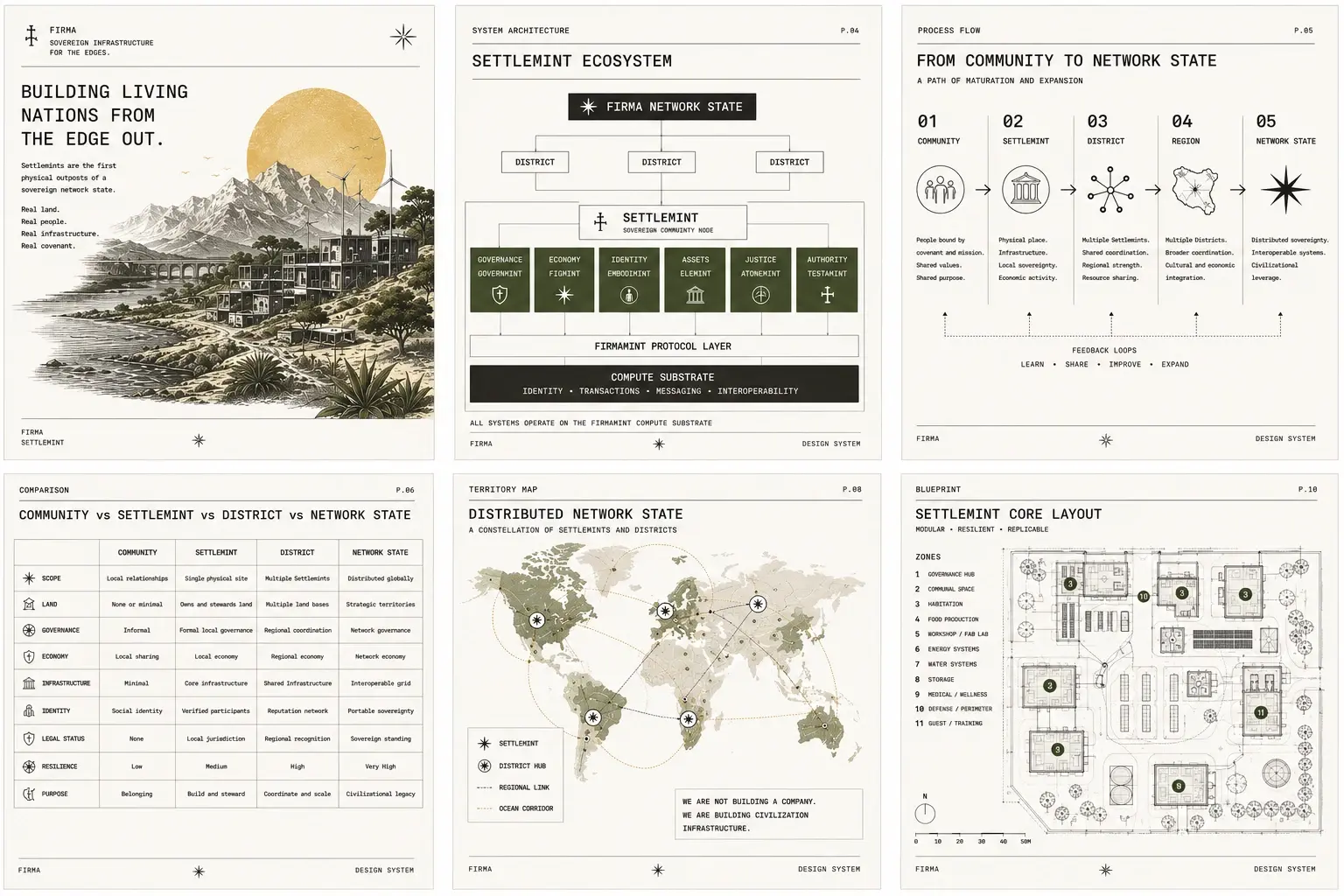
- A Settlemint is a human settlement whose essential systems are integrated enough for people to live, build, govern, exchange, produce, coordinate, and belong with increasing operational autonomy.
- → CH_04 · What Is a Settlemint?
- Settlemint stack
- The integrated protocol collection enabling functioning settlements — Firmamint, Governmint, Embodimint, Elemint, Figmint, Atonemint, and Testamint. The functions are canonical; module names and technical implementations remain provisional.
- → Firma org architecture
- Signal
- An observable indication that a capability, identity, or institution may be emerging.
- → CH_05 · Claim Is Not Proof
- Sovereign infrastructure
- Sovereign infrastructure increases the ability of people or communities to control, govern, replace, interoperate with, or survive the failure of systems critical to their lives.
- → CH_08 · Building for the Edges
- Sovereign state
- A sovereign state possesses ultimate governing authority over a population and territory and functions independently in international relations.
- → CH_06 · From Community to Network State
- Sovereignty
- Sovereignty is the highest governing authority within a political order.
- → CH_03 · What Is Sovereignty?
- Startup society
- A startup society deliberately organizes around a binding principle and the intent to build a different social order.
- → CH_06 · From Community to Network State
- State
- A state is an enduring political structure that exercises governing authority over a population and territory.
- → CH_01 · Nation, State, Country, Government, and Polity
T
- Testamint
- Testamint concerns faith, covenant, witness, formation, inheritance, and continuity across generations. Testamint is specific to covenantal formation; Settlemint is the broader settlement category.
- → CH_09 · Where Firma Fits