✴ Part III — ArchitectureCH_07
Realm, Settlemint, District, and Constellation
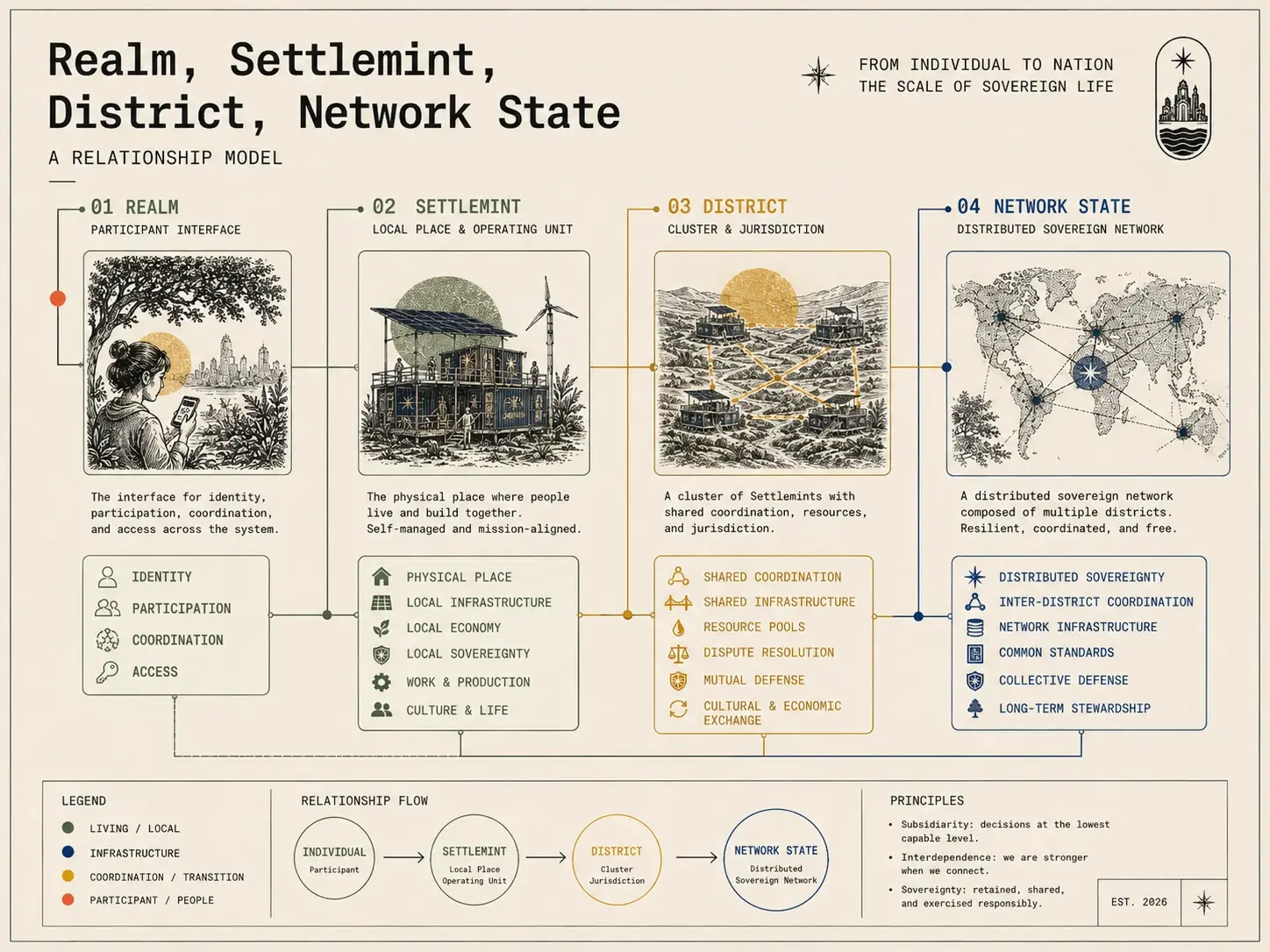
Realm is the personal edge. Settlemint is the embodied place. District is the constituent city-polity. Network state is the larger political community. Constellation is the possible relationship among distinct polities.
Realm is the personal edge.
Settlemint is the embodied place.
District is the constituent city-polity.
Network state is the larger political community.
Constellation is the possible relationship among distinct polities.
This chapter explains the conceptual relationship. Proprietary technical implementation belongs in The Firma Architecture.
These categories describe different scales and functions. They should not be collapsed into one hierarchy or treated as interchangeable product names.
The central principle
The parts remain distinct. Shared infrastructure lets them compose.
A healthy system becomes more capable as its parts connect without requiring every person, place, or polity to lose its identity, stewardship, authority, or purpose.
Realm: the personal edge
A Realm is the living personal edge domain through which a person or household participates in the greater network.
A Realm may be expressed through devices, identity, personal AI, local compute, connectivity, energy, permissions, contribution history, ownership, and trusted context.
It is not merely:
- an account,
- a wallet,
- a profile,
- an AI assistant,
- a router,
- or a bundle of devices.
The devices may change while the Realm persists.
The Realm preserves the person or household as a stewarded domain rather than reducing them to a user record inside a platform.
Your Realm is your part of the whole.
Settlemint: the embodied place
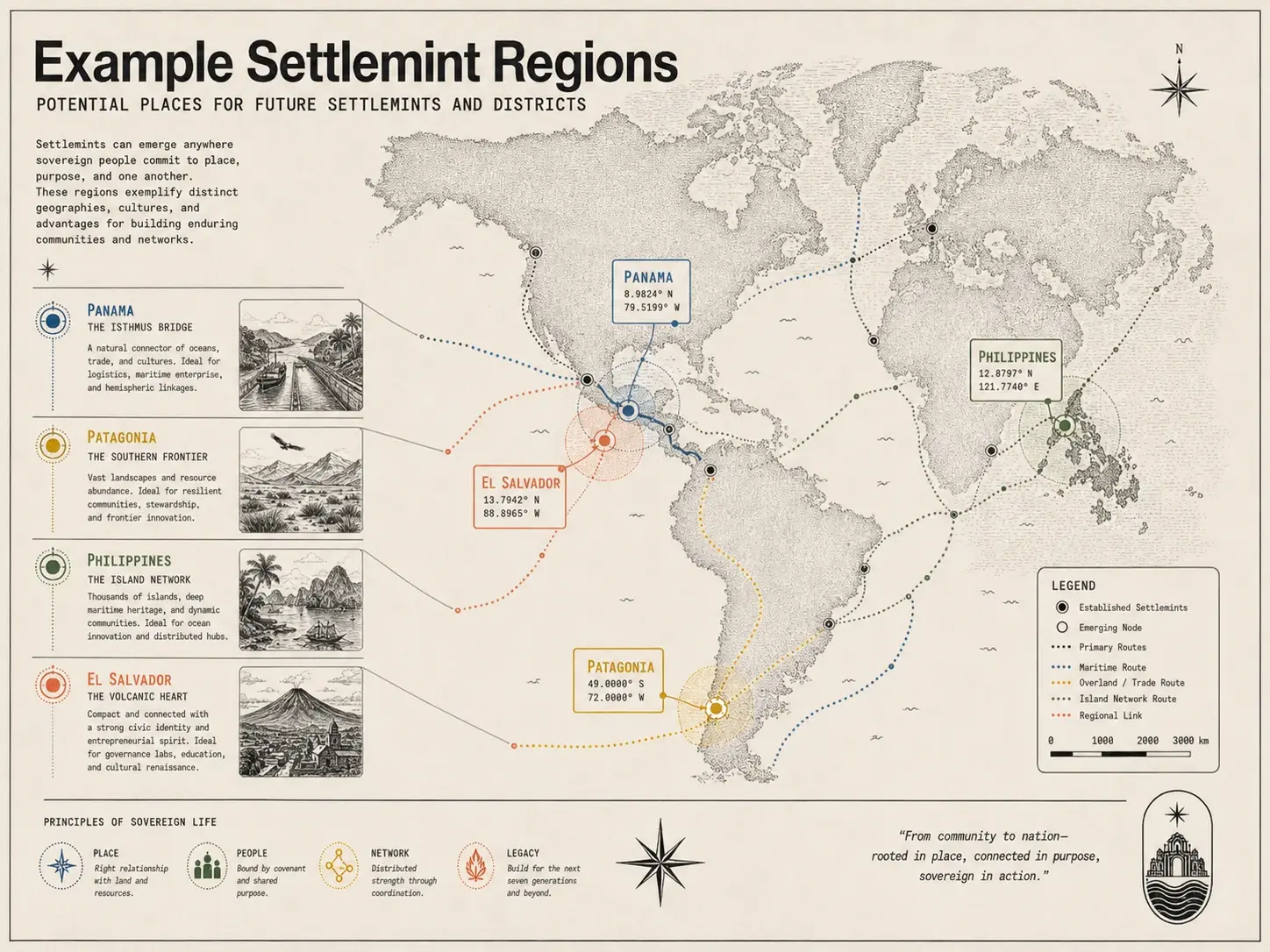
A Settlemint is a human settlement whose essential systems are integrated enough for people to live, build, govern, exchange, produce, coordinate, and belong with increasing operational autonomy.
The Settlemint concerns the life of a real place.
A Realm may contribute compute, connectivity, energy, identity, memory, or economic activity to a Settlemint. But the distinction remains:
The Realm belongs to the person or household. The Settlemint belongs to the shared life of the place.
A Settlemint should not absorb personal stewardship. Many Realms may strengthen a settlement while remaining distinct.
District: the constituent city-polity
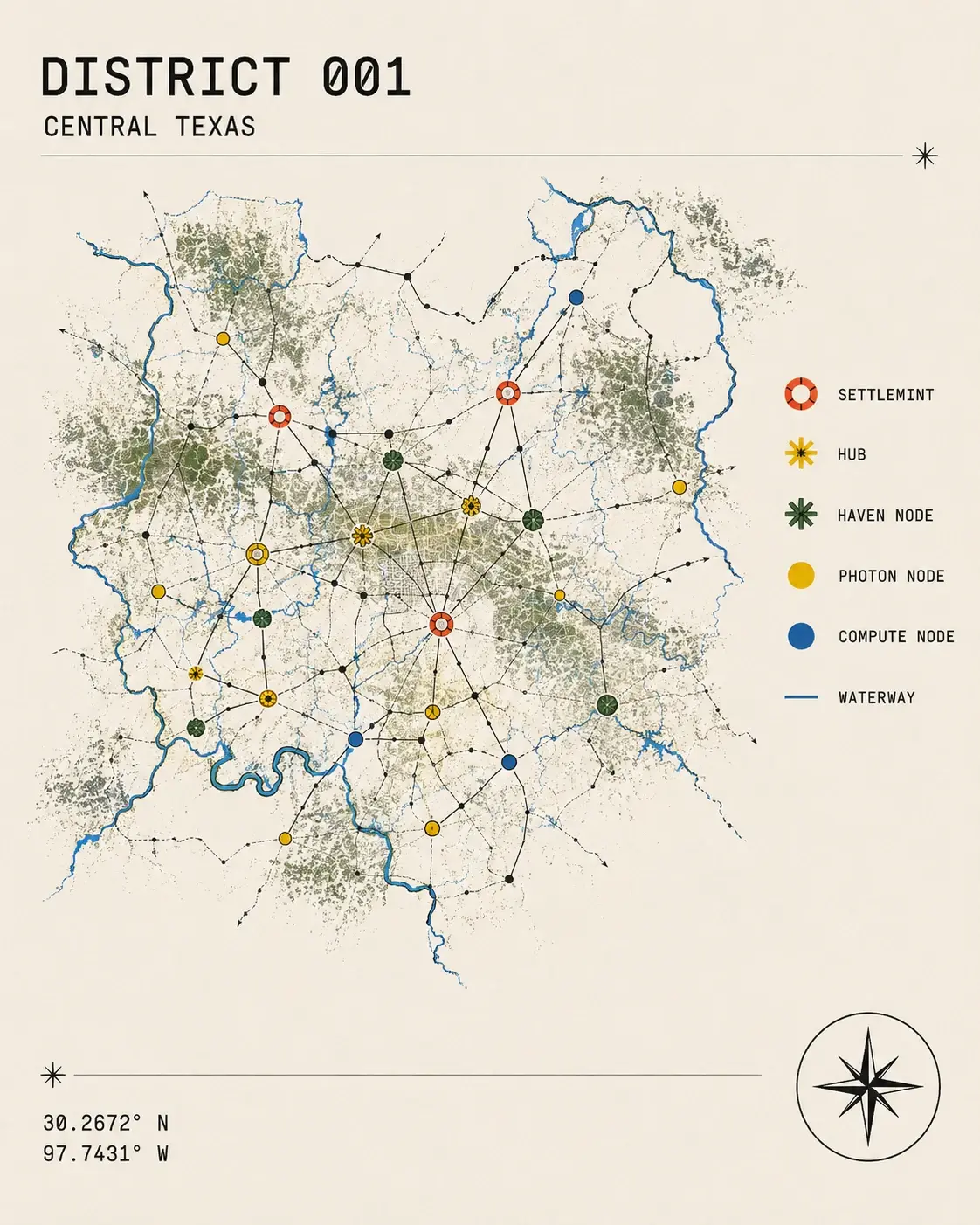
A District is a constituent city or city-like polity capable of governing meaningful domains of common life while belonging to a larger political nation.
Within the Nation of Heaven concept, Districts are envisioned as substantial local political units—not merely administrative regions or clusters of properties.
A District should eventually demonstrate:
- a durable people in place,
- civic identity,
- legitimate governance,
- enduring institutions,
- an economy and treasury,
- infrastructure stewardship,
- dispute resolution,
- representation in the larger political whole,
- and real autonomy or authority across defined domains.
The word sovereign expresses the intended direction, but it must not be used to claim legal status that has not been established.
A District may have significant local authority while remaining subordinate to an existing sovereign state in criminal law, foreign relations, borders, defense, or other domains.

Settlemint versus District
The categories answer different questions.
A Settlemint asks: Can this place sustain a people?
A District asks: Can this city-polity govern meaningful parts of its common life?
A District may contain one mature Settlemint, several Settlemints, or another future settlement pattern.
A Settlemint may also exist outside any District or network state.
A Settlemint proves function in place. A District proves political capacity in place.
Network state: the political community
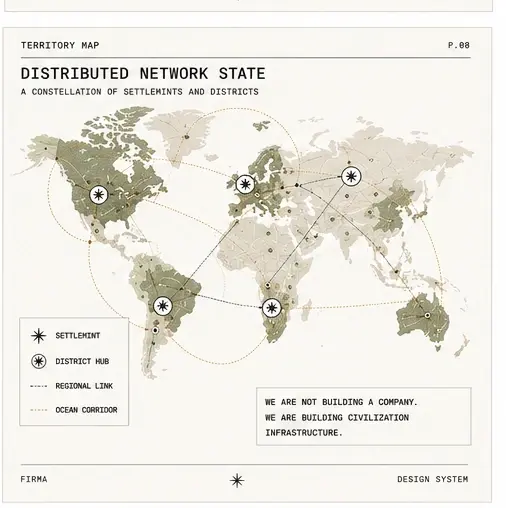
A network state is the larger network-born political community that its people, institutions, and embodied places may compose.
One network state may contain many Districts or Settlemints across different regions.
Those places may differ in:
- local law,
- climate,
- infrastructure,
- economic role,
- cultural expression,
- population,
- and degree of autonomy.
They do not need to be identical. Shared peoplehood, institutions, governance, and external standing may connect them politically.
The District preserves local political life. The network state preserves the larger peoplehood and political whole.
Constellation: distinct polities, shared capacity
A category may eventually be needed above a single network state.
A Constellation is a voluntary higher-order network of distinct polities that remain politically themselves while coordinating selected capabilities, infrastructure, standards, and reciprocal commitments.
The term remains provisional because the institutional relationship is not yet defined.
A Constellation would not be:
- one network state,
- an empire,
- automatically a federation,
- automatically a confederation,
- merely a protocol ecosystem,
- or a loose branding partnership.
It would need to coordinate something real over time, such as:
- communications,
- compute,
- energy,
- payments,
- trade,
- mobility,
- standards,
- mutual aid,
- emergency response,
- or shared infrastructure.
The minimum rule is:
No new layer without a new function.
Districts and allied network states are not the same
This distinction is essential.
A District belongs constitutionally or politically to the larger Nation.
An allied network state remains a peer polity.
Districts compose the Nation. Allied network states may compose a Constellation.
The first relationship is constituent. The second is relational.
Shared infrastructure does not require shared sovereignty
Distinct people, settlements, Districts, or network states may share:
- communications,
- compute,
- economic rails,
- identity interfaces,
- standards,
- emergency systems,
- or interoperable records.
That does not automatically create one central political authority.
Shared substrate is not the same as centralized rule.
The political question is always:
- Who controls the shared system?
- Who can refuse?
- Who can exit?
- Who can override whom?
- Can infrastructure be weaponized against a participant?
- Which powers were actually delegated?
Without credible answers, a supposedly plural network may become a hidden empire.
Composition is not containment
A simple diagram might suggest:
Person → Realm → Settlemint → District → Network State → Constellation
But the architecture is more relational than hierarchical.
- A Realm can move between places.
- A Settlemint can exist outside a District.
- A District may contain one or many Settlemints.
- A network state may contain distributed settlements across several jurisdictions.
- Distinct network states may share infrastructure without becoming one state.
Do not confuse composition with containment.
What each category preserves
| Category | Primary function | What it preserves |
|---|---|---|
| Realm | Personal participation and capability at the edge | Personal or household stewardship |
| Settlemint | Functional human settlement | Embodied life in place |
| District | Local political and civic organization | Local identity, governance, and authority |
| Network state | Larger political organization across distance | Shared peoplehood and political standing |
| Constellation | Selected cooperation among distinct polities | Political plurality with shared capacity |
What remains provisional
The conceptual distinctions are now strong enough to preserve, but several institutional questions remain open:
- the final legal and political meaning of a District,
- the division of authority between District and Nation,
- membership, representation, entry, and exit,
- the final definition and name of Constellation,
- which functions should remain local or become shared,
- how shared infrastructure avoids political capture,
- and the technical role of Firmamint across the layers.
Those questions belong in The Frontier Standard and The Firma Architecture, not inside this introductory conceptual chapter.
The lines to remember
Realm is the personal edge. Settlemint is the embodied place. District is the local city-polity. Network state is the larger political community.
And:
The parts remain distinct. Shared infrastructure lets them compose.
✴ Last updated · Sun Jul 19 2026 00:00:00 GMT+0000 (Coordinated Universal Time)