✴ The Settlemint Handbook · ModulesHB_02
Membership and Belonging: Who Belongs and Who Decides
Belonging is the recognized relationship through which a person can truthfully say, "I am part of this, and this people or place has a claim on my responsibility."
Who are we? Who belongs? How do we decide?
Every civilization must answer these three questions. Technology cannot answer them by itself. A people must.
Belonging comes before administration
Do not begin with databases, credentials, voting systems, or citizenship documents. Begin with belonging.
Belonging is the recognized relationship through which a person can truthfully say, "I am part of this, and this people or place has a claim on my responsibility."
Belonging is not merely emotional affinity. It creates relationship, responsibility, memory, and expectations.
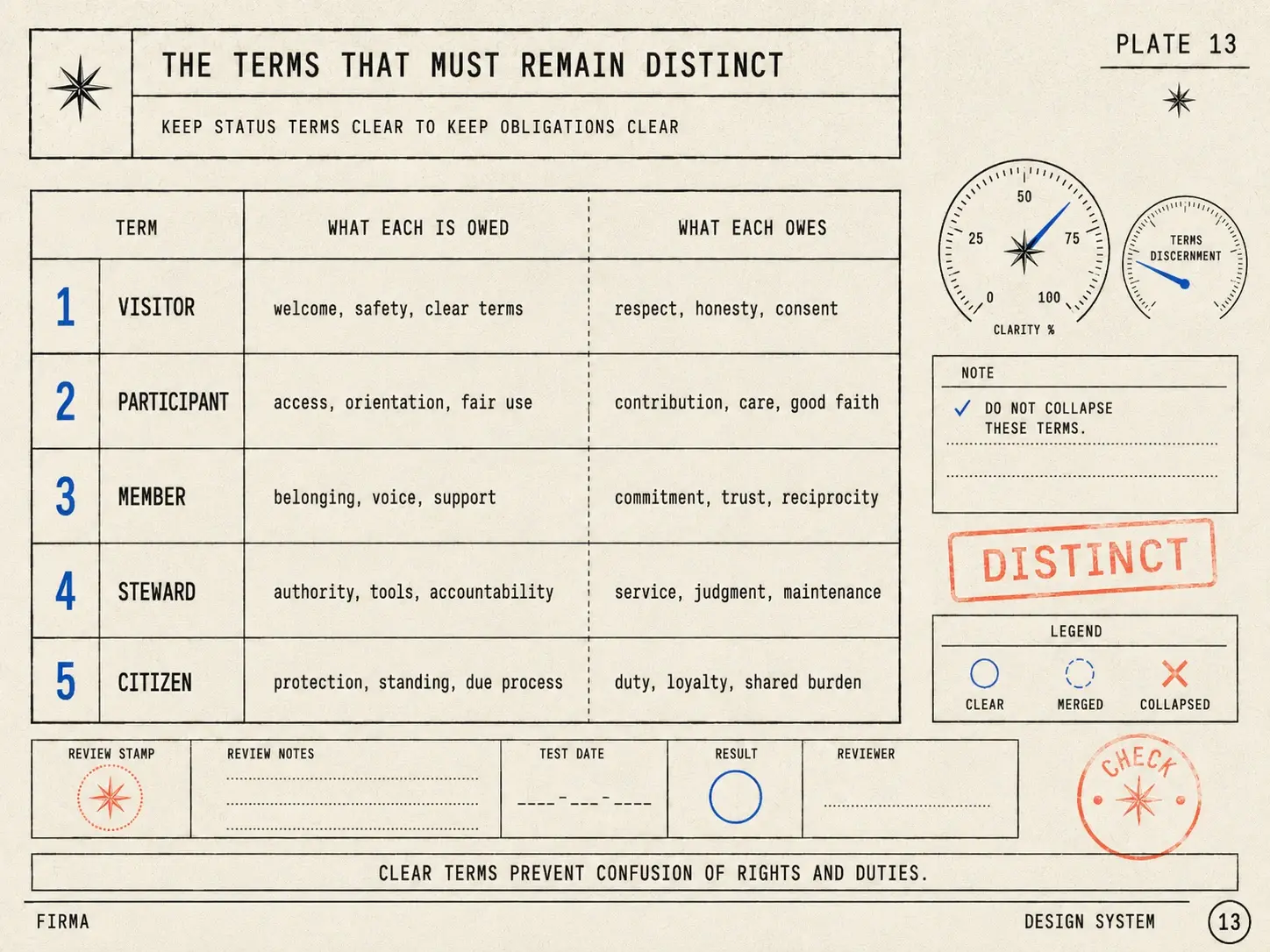
Terms that must remain distinct
Visitor
Present temporarily; receives hospitality or access without full membership obligations.
Participant
Contributes or takes part in an activity. Participation does not automatically create membership or political rights.
Member
Has a recognized, defined relationship with the community or institution. Membership normally creates both privileges and responsibilities.
Resident
Actually lives in a place. Residence may matter greatly without automatically granting every form of membership or citizenship.
Steward
Carries responsibility for something entrusted to their care: land, infrastructure, a Realm, treasury, institution, ministry, or commons. Stewardship is not identical to ownership or political rank.
Representative
Authorized to speak or decide on behalf of others within a defined scope.
Governor or officeholder
Holds legitimate decision-making authority in an institution or polity. Office is a responsibility, not proof of superior human worth.
Citizen
Citizenship belongs to a political community and normally carries defined legal or constitutional rights and duties. Not every Settlemint needs citizens. A District or Nation may eventually require a citizenship framework.
Belonging is not one universal ladder
These terms describe different relationships. They should not be treated as a single rank progression where one is always "higher" than another. A resident may not be a steward. A steward may not be a political representative. A participant may contribute greatly without being a citizen.
Name the relationship precisely instead of creating vague status tiers.
Belonging at each layer
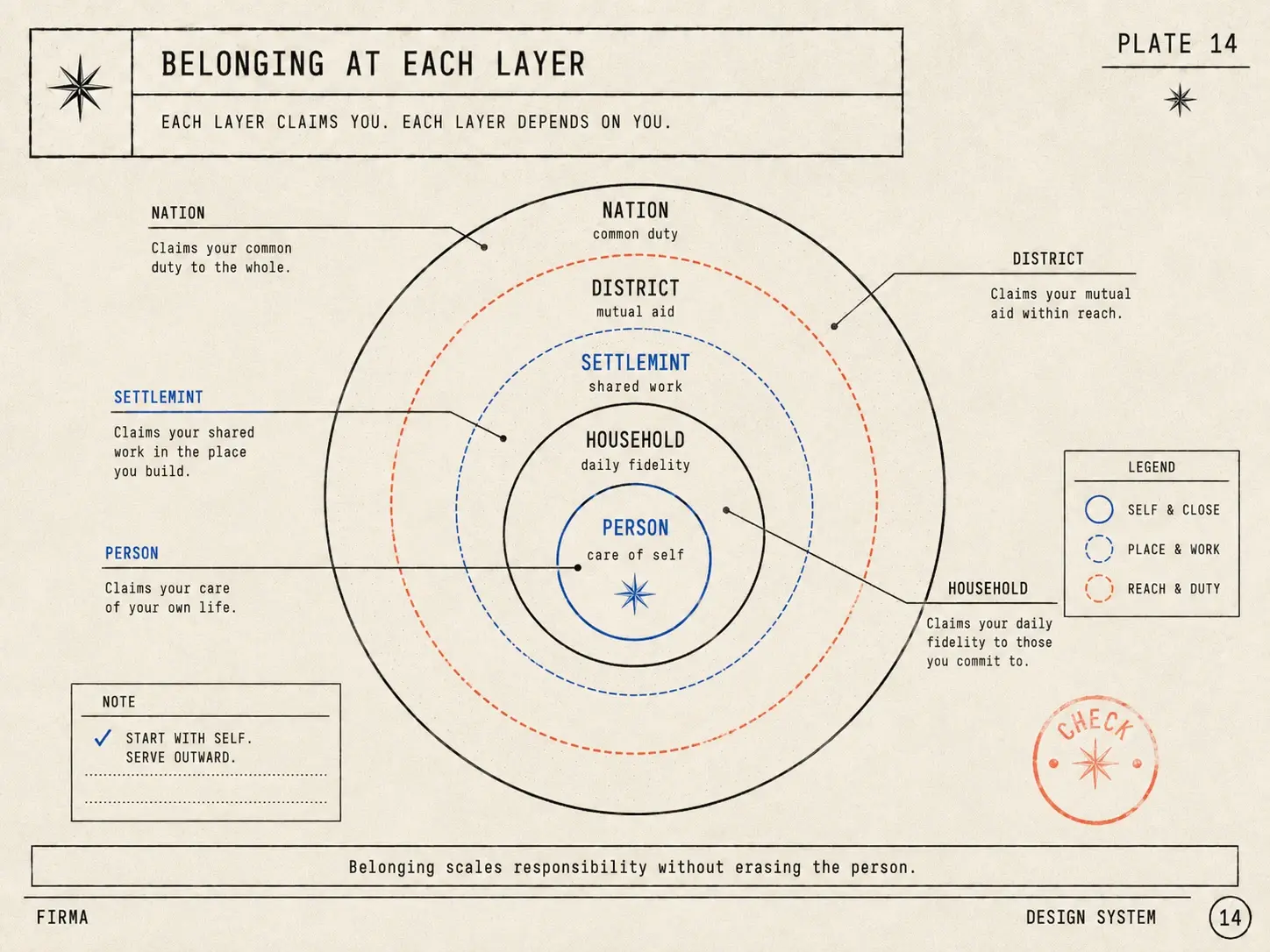
To a Realm
Realm questions are personal and household-level: Who stewards the Realm? Can a household share one Realm? What remains individually private? Can children have developing Realm identities? How do inheritance and succession work? Which agents may act on behalf of the person or household?
The Realm should preserve personal agency and household responsibility.
To a Settlemint
Settlemint belonging may involve several distinct relationships: resident, worker, builder, guest, member, property steward, investor, worshipper, service provider, or long-term contributor. Do not assume all relationships carry the same rights.
A Settlemint needs a clear answer to:
Who may live here, use shared systems, participate in decisions, receive care, carry obligations, and remain through conflict?
To a District
District belonging becomes political: residence, local citizenship, representation, civic duties, taxation or treasury contribution, local law, public institutions, infrastructure stewardship, and participation in District governance.
Districts are where politics becomes local again.
The District should be strong enough to govern meaningful local matters without absorbing every personal or settlement decision.
To the Nation
The Nation question is not merely where someone lives or which software they use. It asks:
Who are "we," and what binds us as one people?
Nation-level belonging may involve shared identity, covenant or founding commitments, political membership, mutual responsibility, representation, common institutions, and a shared future.
For the Nation of Heaven, this relationship is explicitly covenantal and Christian. That does not make every Settlemint Christian by definition.
Contract and covenant
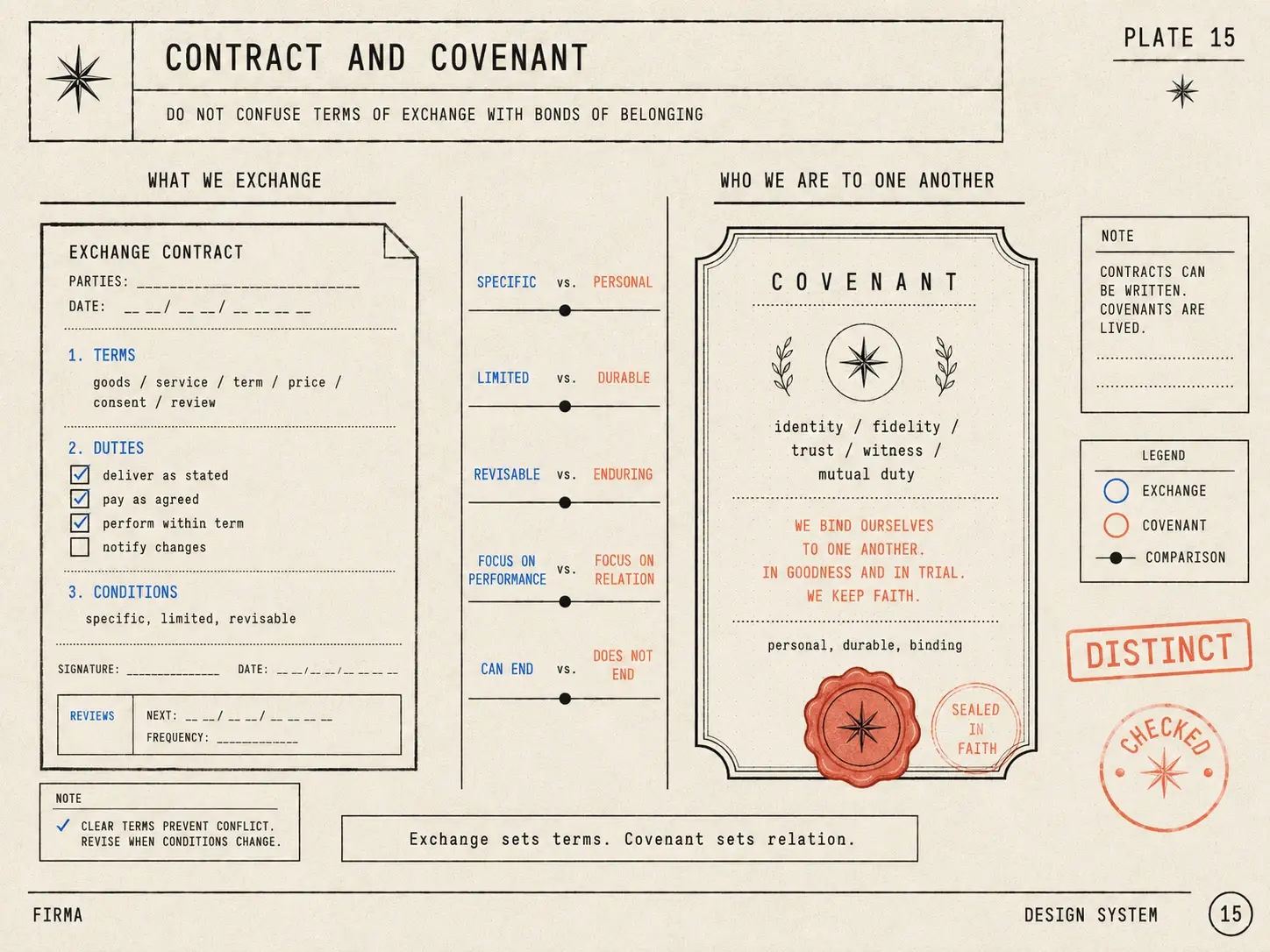
A contract asks:
What have we agreed to exchange or perform?
A covenant asks:
Who are we to one another, and what are we responsible to become and preserve together?
Covenant does not eliminate contracts, rules, constitutions, or legal clarity. It explains the deeper relationship those instruments are meant to serve. Use covenant where it is authentic — especially in the Nation of Heaven and Testamint — not as a decorative word for every commercial arrangement.
Governance and legitimacy
Governance is how a people repeatedly make, execute, review, and correct legitimate decisions together.
Governance includes authority, decision-making, execution, accountability, representation, succession, resource allocation, dispute resolution, correction of bad leadership, and protection of legitimate boundaries. Voting is one tool. Governance is much larger — the handbook treats it in its own module.
Legitimacy asks why affected people accept the right of an authority to decide. Possible sources include consent, covenant, law, tradition, representation, performance, office, ownership, or recognized spiritual authority. These sources can conflict. The handbook names those conflicts rather than hiding them.
Subsidiarity
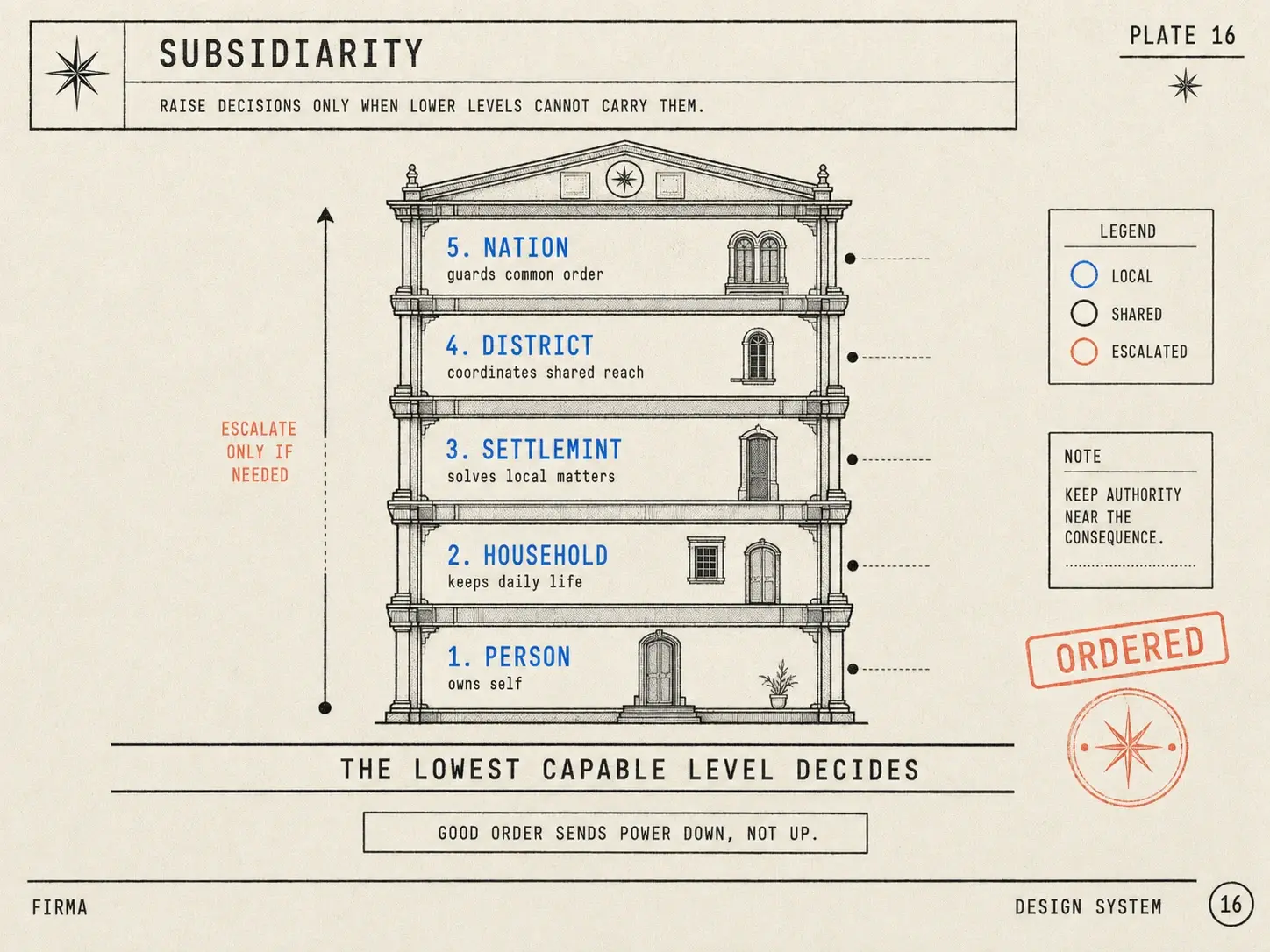
Make each decision at the smallest level capable of handling it well.
Personal matters remain personal. Realm matters remain with the Realm or household. Settlemint matters remain local when possible. District matters are handled by the District. Nation-level matters go to the Nation. Constellation matters are limited to genuinely shared concerns.
Subsidiarity is not automatic decentralization. Some problems require wider coordination. The test is capability, impact, legitimacy, and accountability.
Founder dependence
Founders naturally carry disproportionate responsibility during formation. But:
If every meaningful function stops when the founder leaves, the institution is not yet mature.
The goal is not to erase founders. It is to build legitimate roles, shared knowledge, succession, and durable capacity beyond one person.
Belonging creates a people
Technology can coordinate people. Infrastructure can empower people. Economics can reward people. Governance can organize people.
Belonging is what allows individuals to understand themselves as a people.
This is not automatic and cannot be manufactured by branding alone.
What remains open
The membership systems themselves are unresolved and must be answered by each community — and, for the Nation of Heaven, at the political level: Realm ownership, household sharing, and inheritance; Settlemint membership categories and rights; District citizenship; covenant requirements; the relationship between faith, political membership, residence, and participation; representation across Districts; entry, discipline, removal, appeal, and exit; and how spiritual authority and civil authority relate without being confused.
These are presented as the questions a Settlemint must answer — not as answers the handbook has already given.
✴ Last updated · Tue Jul 21 2026 00:00:00 GMT+0000 (Coordinated Universal Time)