✴ The Settlemint Handbook · ModulesHB_05
Starting a Settlemint
How a Settlemint actually begins — with people and place rather than software, an honestly chosen origin path, a minimum viable threshold that must be met before the name is claimed, and a first functioning system that turns real needs into verified work and evidence-based trust.
A Settlemint is not started by announcing one. The category is earned through function, and function begins small: real people, a real place, a real need, and one system that works. This module describes how a settlement begins without overclaiming — what must exist before the word Settlemint is used, and what to build first. It draws its operating practice from ATX, the genesis Settlemint in formation whose fuller treatment is in the ATX chapter, and its definitions from What Is a Settlemint?.
The governing order of operations:
Do not start with the module names. Start with what human life in place must actually be able to do.
Begin with people and place, not software
The published record of the first attempt is explicit: ATX did not begin with software or a token. It began with people and place.
A settlement's real starting condition looks less like a protocol and more like an inventory of relationships and responsibilities: people, trusted relationships, capital, a real property with real maintenance needs, builders and operators, ministry, mission, and cultural partners, and the willingness to begin before everything is solved. That is enough to start learning. It is not enough to claim completion.
The distinction between what can be acquired and what must be grown is doctrine:
Infrastructure can be purchased. Trust, shared purpose, and institutional memory must be cultivated.
Software, records systems, and coordination tools enter the picture only after there is something real to coordinate. The stack exists to serve the settlement, never the reverse — the full discipline is in the stack module.
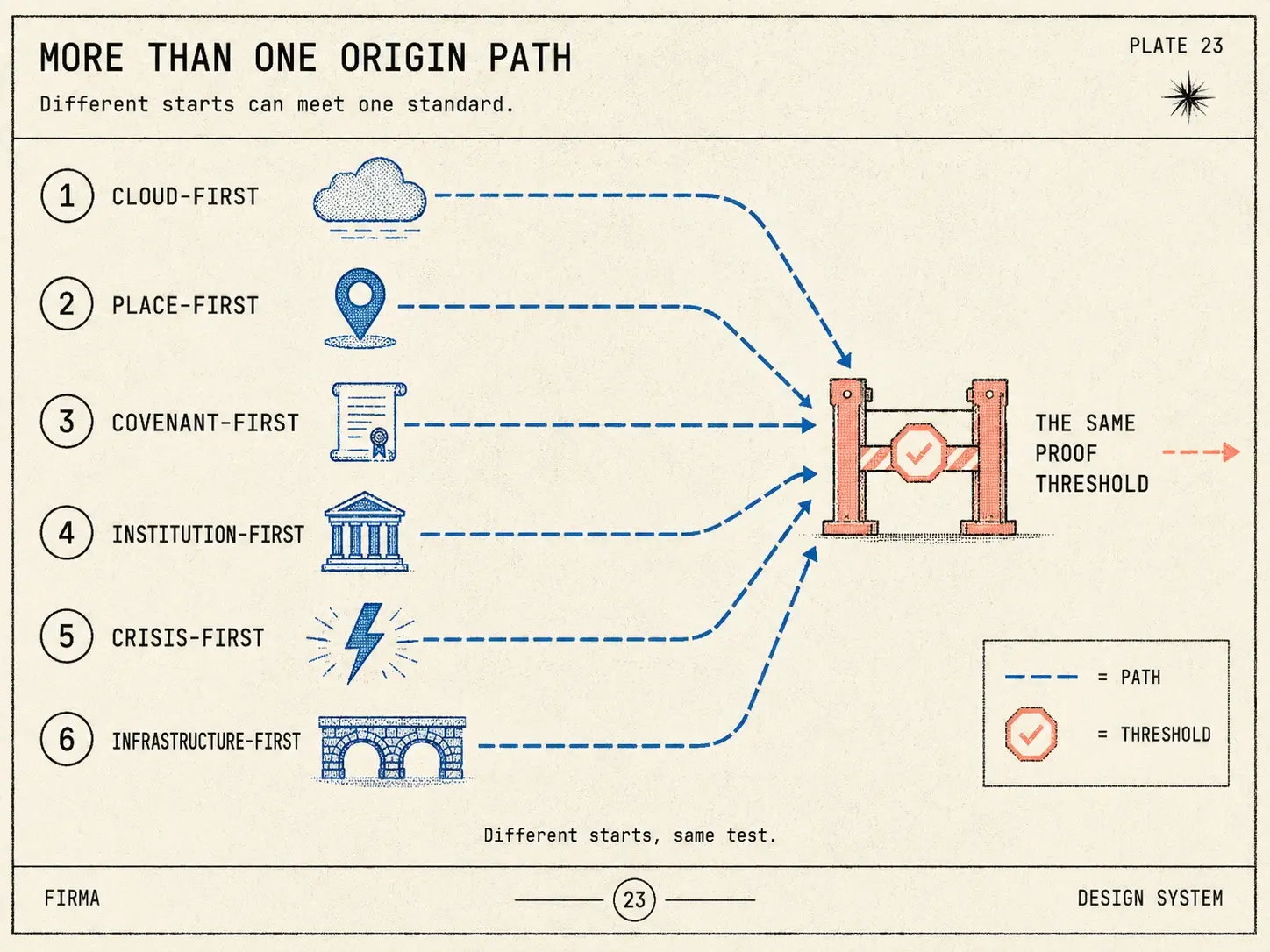
More than one origin path
The original network-state pathway is cloud-first:
online community → collective action → land → recognition
A Settlemint may emerge differently:
Covenant first. People and place together. Network everything.
That second line remains provisional until reality supports it, but the pathway matters. A Settlemint may begin from an existing community, a church, a compound, a village, a frontier site, a humanitarian mission, a university, a distributed network, or a network state acquiring land. The category should describe settlement maturity without forcing every place into one origin story.
Choosing an origin path honestly matters at the start because it determines what already exists and what must still be proved. A covenant-first settlement may begin with people, purpose, and place already joined — and still lack governance, economy, memory, and continuity. A cloud-first community may have coordination and treasury — and still lack habitation and everything that comes with it. Neither starting point is the finished thing.
Before the name is claimed
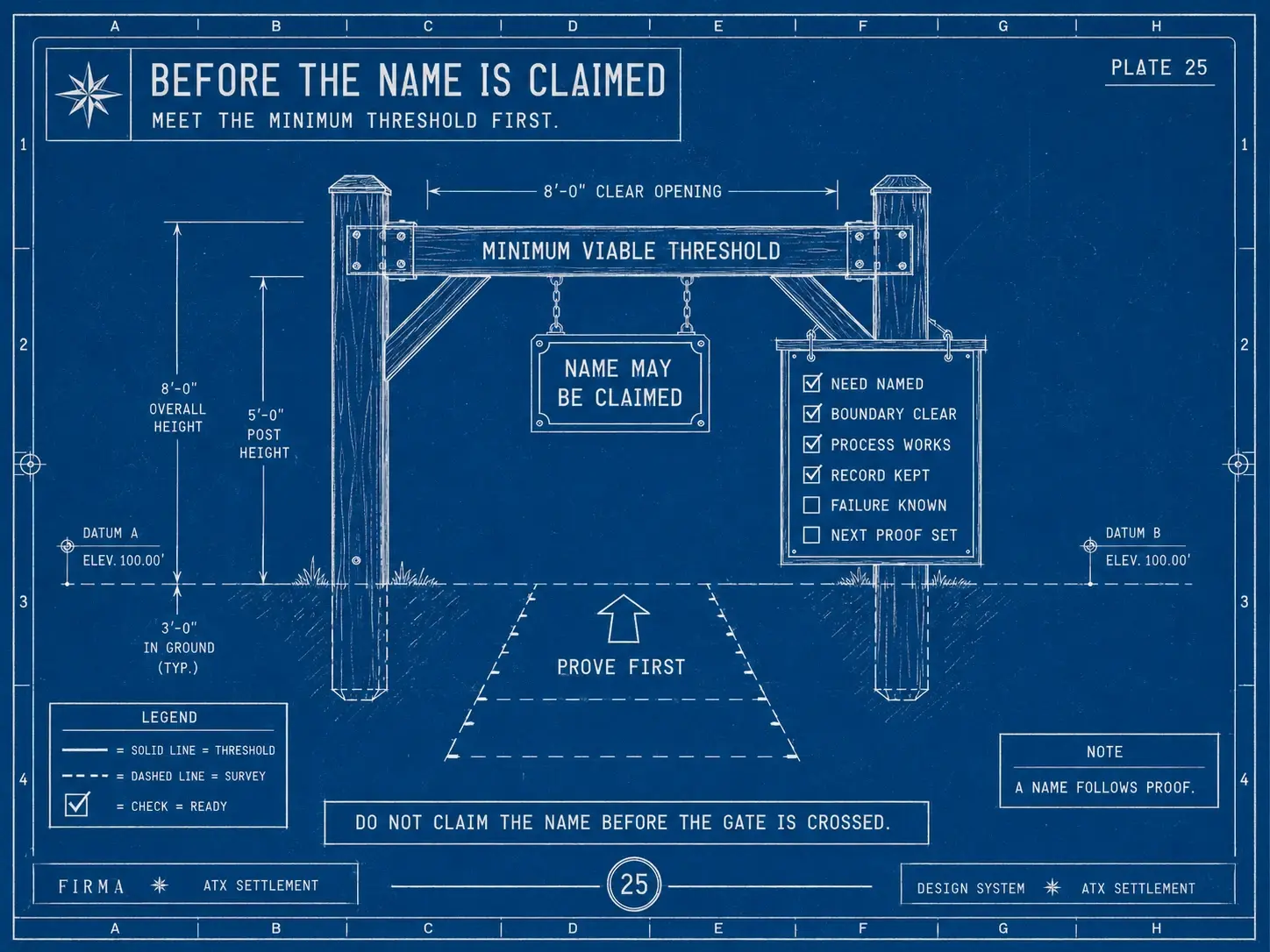
The word Settlemint should be conceded last, not claimed first. The current working threshold, from the published definition:
A persistent community inhabits a real place, shares a purpose, can make and execute decisions, coordinates real economic or productive activity, operates meaningful infrastructure, preserves institutional memory, and demonstrates durable capacity to continue.
This threshold remains provisional and deliberately qualitative. It must eventually become a testable maturity standard rather than a rhetorical label. Until a starting community meets it, the honest language is a Settlemint in formation, which is exactly the status ATX holds. How a community assesses itself against this threshold — the proof ladder, the evidence ledger, and the tests that expose false institutions — is the subject of the maturity module.
Starting, in other words, is not a naming event. It is the beginning of the evidence a ledger will record.
The first system is a loop
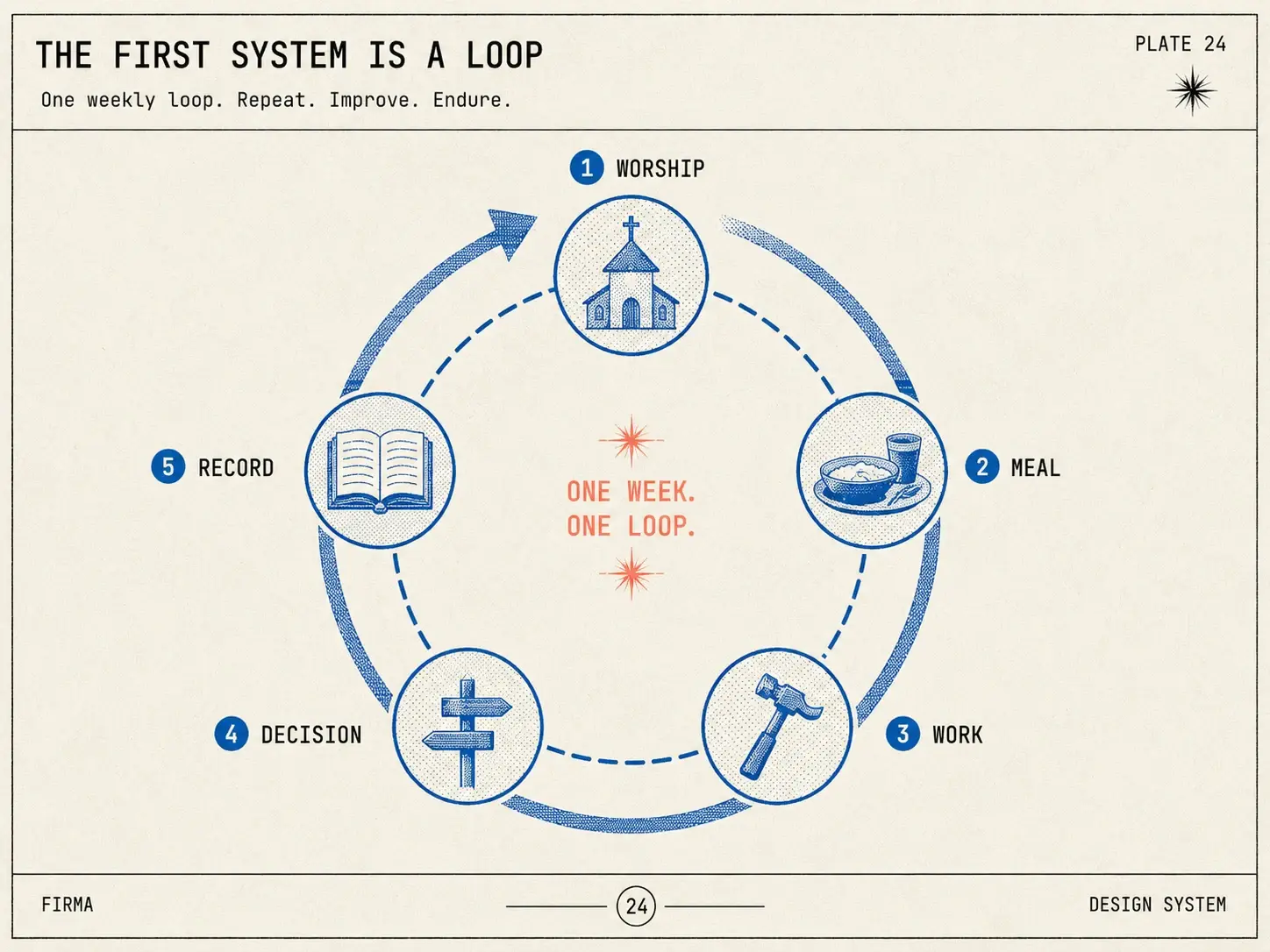
The first system a starting settlement should build is not a governance framework, an economy, or a technology platform. It is a working coordination loop — the smallest useful settlement loop. In its current form this is the proto-Settlemint v0 working loop, piloted at ATX. As a system it is working practice in formation, not a finished protocol:
Need → Claim → Act → Verify → Earn / Give → Reputation → Greater Trust
A settlement becomes real when people can repeatedly see what is needed, take responsibility, act, verify outcomes, move value clearly, preserve evidence, learn who can be trusted with what, and become stronger through what was built or freely given.
The stages, in working terms:
- Need — a real need is recorded clearly: what is needed, why it matters, who benefits, what capability is required, and what completion would look like.
- Claim — a person accepts responsibility, and the commitment is explicit: who is responsible, what they are committing to, and what happens if the commitment changes. The system should reward honest withdrawal over silent failure.
- Act — real work happens. Contribution is broader than labor: capital, materials, equipment, space, knowledge, hospitality, transport, creative work, and care all count.
- Verify — a qualified person confirms the outcome and the evidence. Verification is not a popularity vote, and not every contribution needs the same verification burden.
- Earn / Give — value moves clearly, and the categories are not blurred: compensation, reimbursement, grant, bounty, stipend, or gift — and, recorded separately, freely given excess. The system must not treat every act of generosity as unpaid labor that should have been compensated, nor every paid act as less meaningful because money was involved.
- Reputation — reputation should be evidence, not a score. It preserves demonstrated capability, verified completion, reliability, generosity, and stewardship, in context.
- Greater trust — more evidence can lead to more responsibility, access, authority, autonomy, or opportunity. Greater trust should be contextual, not universal.
The loop succeeds when a real person can see a real need, claim it, do the work, submit evidence, be verified by the right person, be paid or record a freely given contribution, and build durable evidence of capability — all without needing to understand the underlying infrastructure.
The loop's disciplines
The working loop carries its own guardrails, and a starting settlement should adopt them from day one:
- Complete the first real needs end-to-end before adding complexity. ATX's working practice is a first-ten-needs test: before building complex economic or governance machinery, complete ten real needs all the way through the loop and capture what each one teaches. The first ten needs are a product-design dataset, not a marketing statistic.
- No global reputation score. A person should not be reduced to a global number. Reputation is a body of contextual evidence — capability, reliability, generosity, stewardship — never a single ranking, and never a measure of human worth.
- Nothing sensitive on an immutable public ledger. Private personal data, hardship context, and sensitive evidence stay off any permanent public record by default. What deserves durable public attestation should be discovered through real use, not assumed.
- Do not turn generosity into coerced free labor. Freely given excess is recorded and honored as what it is.
One functioning system at a time
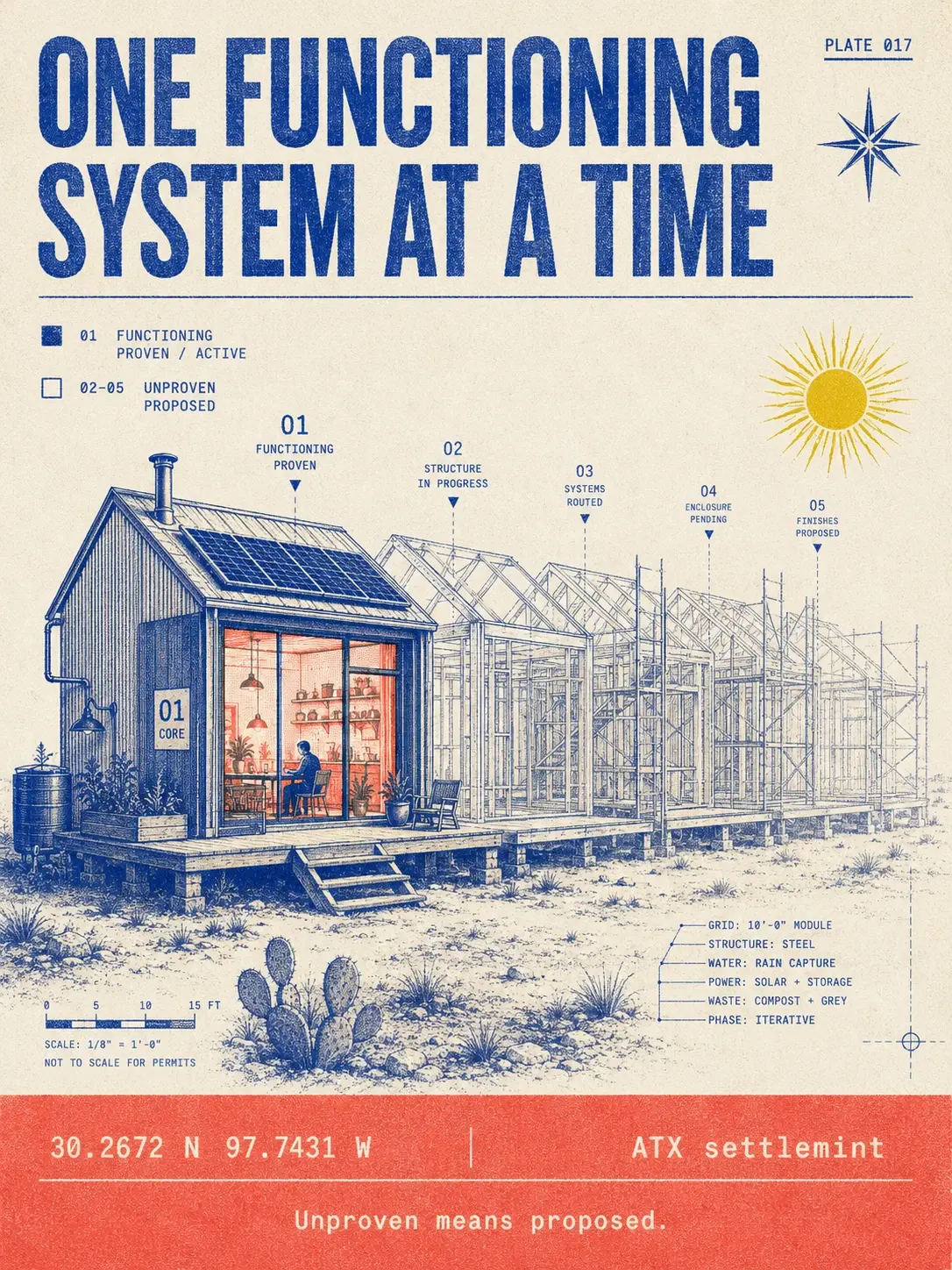
The published doctrine from the ATX reference implementation applies to any starting settlement: build one functioning system at a time rather than claiming the entire Settlemint stack already exists.
Generalized from ATX's published first-systems list, the early systems of a starting settlement are versions of these:
- Community rhythms — recurring patterns of gathering, meals, work, rest, decision-making, and hospitality.
- Formation — whatever practice carries the community's shared purpose, kept central rather than decorative. (ATX's covenantal identity is specific to ATX; it is not a universal requirement for the category.)
- Stewardship of place — restoration, maintenance, prioritization, budgeting, and accountable operating responsibility for the land and buildings.
- Hospitality — reliable capacity to host without constant improvisation.
- Land systems — food, water, soil, and ecological care appropriate to the actual site.
- Training — forming people practically for real service.
- Governance — clear decision rights, stewardship roles, financial controls, and a process for correcting failed decisions.
- Economic coordination — real productive activity, transparent resource flows, and repeatable economic loops.
- Infrastructure resilience — critical systems becoming more reliable and less dependent on single points of failure.
- Institutional memory — remembering who contributed, what was decided, what was spent, what failed, and what obligations remain.
Two published rules govern the early build:
Governance begins when decision rights, obligations, and accountability become clear enough to practice repeatedly.
Subsidy can begin a system. Only repeated productive function can prove that it endures.
Each system should be built to the point where it functions repeatedly before the next layer of complexity is added. The proto-Settlemint loop is itself the first entry on this list in disguise: it is the settlement's coordination, memory, and trust systems beginning as one small working practice.
Unproven means proposed
A starting settlement will be surrounded by named future systems — modules, substrates, protocols. The published rule for all of them:
All of this remains proposed unless deployed.
And in its full working form:
Rule: every unproven Firma number, mechanism, economic claim, and protocol capability remains PROPOSED until real deployment proves it.
The named modules of the stack remain working concepts labeled by maturity, not settled systems — see the stack module for the five-question test each name must pass. The proto-Settlemint v0 loop described above is the exception that proves the rule: it is the part of the future stack that a starting settlement can actually run today, and its purpose is to generate the evidence the future modules need to become real.
The human function is canonical. The technical implementation is provisional.
The standard
A starting settlement should be evaluated by the same standard it will grow into:
Claim is not proof. Deployment, endurance, and fruit provide the evidence.
And the line that defines the starting point itself:
The first Settlemint does not begin when the chain launches. It begins when a community can see a need, coordinate around it, act together, preserve evidence of what happened, and become stronger because of what it gave.
✴ Last updated · Wed Jul 22 2026 00:00:00 GMT+0000 (Coordinated Universal Time)