✴ Part I — FoundationsCH_03
What Is Sovereignty?
Sovereignty is ultimate governing authority — not a vibe, a brand, or a synonym for independence. Separating capacity, control, autonomy, authority, jurisdiction, and sovereignty, and introducing the Authority and Autonomy Profile.
Sovereignty is not a vibe, a brand, or a synonym for independence. Sovereignty is ultimate governing authority.
That definition is simple. Applying it correctly is not.
The word sovereign is often used to describe privacy, resilience, self-hosting, ownership, local control, censorship resistance, or practical independence. Those qualities may strengthen a person or community. They are not automatically sovereignty.
The concise answer
Sovereignty is the highest governing authority within a political order.
In the strongest state sense, sovereignty means that an authority has the final legal word within its territory and political order while remaining independent of another state's command.
That is a high threshold. Most people, companies, DAOs, cities, settlements, special zones, and online communities do not possess it.
Why "Is it sovereign?" is usually the wrong first question
A community may:
- generate its own energy,
- control its compute,
- operate a treasury,
- govern membership,
- own land,
- resolve internal disputes,
- or coordinate an economy,
while remaining fully subject to municipal, state, federal, or national law.
A better question is:
Over which domains does this community possess capacity, control, autonomy, authority, jurisdiction, or ultimate sovereignty?
That question reveals the actual structure instead of rewarding inflated language.
The terms that must remain separate
Capacity
Capacity is the practical ability to perform a function.
A community may have the capacity to generate power, operate compute, educate children, provide healthcare, or resolve minor disputes.
Capacity does not prove the lawful right to perform that function.
Control
Control is the practical ability to direct, operate, or exclude others from a resource or system.
Owning land, hardware, communications infrastructure, or treasury assets may create real control.
Control does not automatically create jurisdiction or sovereignty.
Autonomy
Autonomy is the ability to govern or operate within a limited domain while remaining subject to a higher authority.
Autonomy may be legal, contractual, customary, operational, delegated, or tolerated.
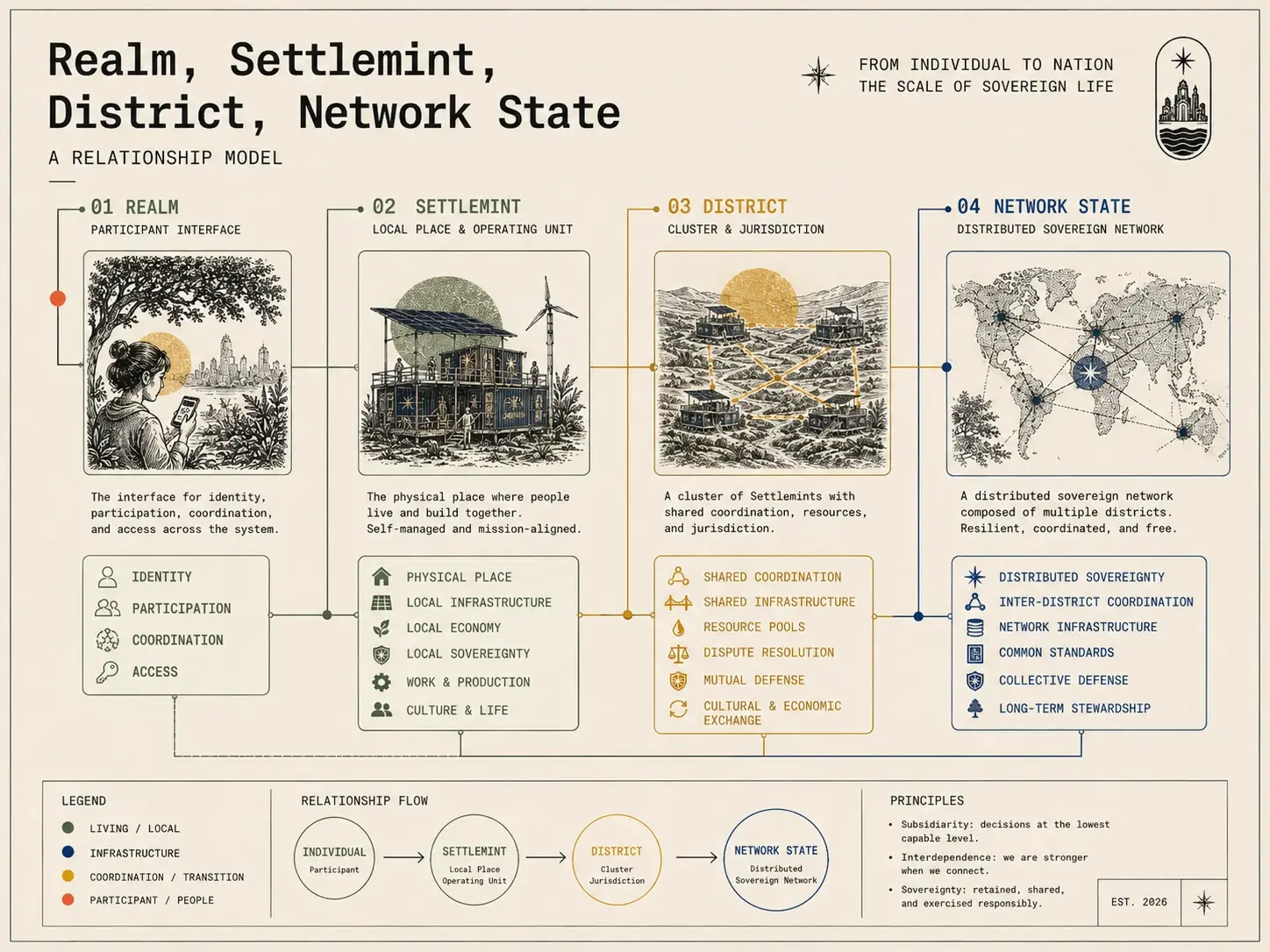
A city may control zoning without controlling foreign policy. A church may govern doctrine and worship without possessing political sovereignty. A Settlemint may operate energy and compute systems while remaining under the laws of the surrounding country.
Authority
Authority is the recognized right to make decisions, issue rules, or direct action.
Authority may arise through:
- law,
- constitution,
- covenant,
- contract,
- ownership,
- election,
- appointment,
- custom,
- or consent.
Authority asks:
Who has the right to decide?
Jurisdiction
Jurisdiction is lawful authority over a particular person, place, subject, or dispute.
Jurisdiction asks:
Where, over whom, and over what does that authority legally apply?
A community may have contractual authority over property use without possessing criminal jurisdiction over residents.
Sovereignty
Sovereignty is ultimate authority: the authority that is not legally subordinate to another authority in the relevant political order.
Do not use this word merely because it sounds stronger than autonomy or control.
Recognition and legitimacy are separate
Recognition
Recognition is when an outside actor acknowledges that an entity possesses a particular status.
Recognition may come from:
- individuals,
- companies,
- municipalities,
- courts,
- regional governments,
- sovereign states,
- or international organizations.
These forms of recognition are not equivalent.
A mayor acknowledging a community is not the same as a sovereign state recognizing another state. A partnership is not recognition of statehood. A protocol listing is not political recognition.
Recognition does not create capacity, and capacity does not automatically create recognition.
Legitimacy
Legitimacy is the belief that an authority has the right to rule or decide.
An institution may possess legal authority but weak legitimacy. A leader may possess social legitimacy but no formal jurisdiction. A technically enforceable system may still be politically or morally illegitimate.
A durable polity needs more than power. It needs people to regard the exercise of that power as rightful.
Internal and external sovereignty
Internal sovereignty
Internal sovereignty concerns the final authority within a political order.
Questions include:
- Who makes final law?
- Who resolves final disputes?
- Who can compel compliance?
- Who controls coercive authority?
- Who ultimately outranks whom?
External sovereignty
External sovereignty concerns independence from other states or political authorities.
Questions include:
- Can another state legally command this polity?
- Does it control its foreign policy?
- Can it enter relations with other states?
- Is it treated as politically independent?
A polity may possess substantial internal autonomy while lacking external sovereignty. This is common.
Personal sovereignty
The phrase personal sovereignty can be useful, but it should not be confused with state sovereignty.
A person may possess:
- bodily agency,
- property,
- privacy,
- identity control,
- mobility,
- economic agency,
- and communications resilience.
For this guide:
Personal sovereignty describes the degree to which a person can exercise meaningful agency and stewardship over their life, identity, property, tools, data, relationships, and participation.
This is practical agency, not legal statehood.
Operational autonomy
Operational autonomy is the practical ability to sustain or govern a function without total dependence on outside systems.
Examples include:
- energy autonomy,
- water autonomy,
- compute autonomy,
- communications autonomy,
- treasury autonomy,
- food resilience,
- educational autonomy,
- healthcare capacity,
- and local production.
Operational autonomy is especially important for Settlemints because a community cannot meaningfully govern what it cannot operate.
But:
Operational autonomy is not legal sovereignty.
A community may produce all its own electricity and still remain fully subject to the law of the country in which it operates.
Jurisdictional autonomy
Jurisdictional autonomy is lawful self-rule inside another sovereign order.
It may arise through:
- municipal powers,
- indigenous governance arrangements,
- special administrative zones,
- private property,
- contracts,
- arbitration,
- religious institutional rights,
- or corporate law.
This is stronger than mere operational control because it involves recognized lawful authority. It remains subordinate where a higher sovereign can override or revoke it.
State sovereignty
A sovereign state generally claims:
- supreme authority over its territory and population,
- independence from another state,
- lawmaking and enforcement authority,
- control of foreign relations,
- and some degree of recognition by other states.
State sovereignty is not established by:
- owning land,
- issuing a token,
- publishing a constitution,
- launching a blockchain,
- holding an internal vote,
- creating a flag,
- or meeting government officials.
State sovereignty must survive legal, institutional, territorial, political, and external scrutiny.
The Authority and Autonomy Profile
The old working term Sovereignty Vector is understandable but potentially misleading because most domains involve capacity, control, or autonomy rather than sovereignty.
The stronger working name is:
Authority and Autonomy Profile
For each domain, ask:
- Capacity — Can the entity perform the function?
- Control — Does it control the relevant systems or assets?
- Authority — Does it have a recognized right to decide?
- Jurisdiction — Where and over whom does that right apply?
- Dependence — Who can interrupt, revoke, or override it?
- Recognition — Who acknowledges the status or authority?
- Legitimacy — Do affected people accept the authority as rightful?
- Continuity — Can the function survive leadership changes or shocks?
- Exit and appeal — Can people leave, appeal, or challenge decisions?
- Ultimate authority — Who has the final word?
This produces a profile rather than a slogan.
Domains to evaluate
A practical profile may cover:
- membership,
- identity,
- governance,
- treasury,
- payments,
- property,
- land use,
- housing,
- work,
- education,
- worship,
- healthcare,
- energy,
- water,
- food,
- compute,
- communications,
- data,
- reputation,
- dispute resolution,
- civil law,
- criminal law,
- taxation,
- public safety,
- immigration,
- foreign relations,
- and defense.
No early Settlemint or network polity should be expected to possess every domain. The purpose is to show the real shape of authority and dependence.
Example: a Settlemint
A Settlemint might have:
- high energy capacity,
- strong compute control,
- resilient communications,
- moderate treasury autonomy,
- strong internal legitimacy,
- contractual authority over property use,
- no criminal jurisdiction,
- no border authority,
- and no diplomatic recognition.
Calling it simply sovereign would hide more than it explains.
A more accurate statement would be:
This Settlemint has meaningful operational autonomy in energy, compute, communications, and treasury, while remaining legally subordinate to the surrounding sovereign state.
Sovereignty is revealed by override
Sovereignty is not only about what an entity can do. It is also about who can stop it.
Ask:
- Who can override the decision?
- Who can revoke the authority?
- Who controls the courts?
- Who can freeze the treasury?
- Who controls coercive enforcement?
- Who can deny access to infrastructure?
- Who has the final appeal?
The final sovereign often appears at the point of override.
Sovereignty is not isolation
Every polity depends on trade, expertise, infrastructure, relationships, and neighboring systems.
The relevant questions are whether those dependencies are:
- chosen or imposed,
- reciprocal or one-sided,
- replaceable or captive,
- transparent or hidden,
- resilient or fragile,
- and governed by legitimate terms.
Sovereignty is not the absence of relationship. It is the ability to enter relationship without surrendering the capacity to govern what is properly yours.
The language ladder
Use the strongest accurate term, not the strongest-sounding term.
Capacity → Control → Autonomy → Authority → Jurisdiction → Sovereignty
This is not always a linear progression. An entity may have legal authority without operational capacity, or practical control without legitimate authority.
The ladder exists to prevent inflation.
Can do. Controls. May decide. May lawfully decide. Has the final word.
These are different claims.
The sentence to remember
Capacity is what you can do. Control is what you can direct. Autonomy is what you can govern within limits. Authority is your recognized right to decide. Jurisdiction is where that right applies. Sovereignty is where no higher authority has the final word. Recognition is who acknowledges your status. Legitimacy is why people accept your rule.
✴ Last updated · Sat Jul 18 2026 00:00:00 GMT+0000 (Coordinated Universal Time)