✴ Part III — ArchitectureCH_08
Building for the Edges
We build for the edges — the frontier, where systems stop being designed for what people are trying to build, and the reach, where systems stop reaching the people they were meant to serve.
We build for the edges.
The edge appears wherever existing systems stop working well enough for the people trying to live, build, serve, or reach beyond them.
Firma names two recurring edges:
The frontier — people operating past where systems were designed to operate.
The reach — people living past where systems were designed to reach.
The conditions differ, but the architectural problem is often similar:
How do people gain the capability to operate where centralized systems are absent, fragile, expensive, extractive, hostile, or insufficient?
The frontier
The frontier is not merely wilderness.
It is any environment where people are attempting something beyond the reliable operating boundary of existing systems.
A frontier may be:
- geographically remote,
- technologically new,
- politically experimental,
- economically underserved,
- infrastructurally constrained,
- institutionally unconventional,
- or simply ahead of the systems meant to support it.
Frontier builders often face a paradox:
The more novel the thing they are building, the less likely existing infrastructure was designed for it.
They may need to assemble their own energy, compute, communications, housing, logistics, payments, coordination, governance, or institutional relationships.
The frontier does not necessarily lack resources. It often lacks systems capable of composing those resources into reliable local capacity.
The reach
The reach describes a different failure.
These are people and places that existing systems were theoretically built to serve but do not reach adequately in practice.
The problem may be:
- distance,
- cost,
- weak infrastructure,
- low commercial incentive,
- political neglect,
- institutional failure,
- conflict,
- disaster,
- or extractive economics.
People at the reach are not merely recipients. They may already possess land, labor, knowledge, relationships, natural resources, energy potential, culture, and local intelligence.
The stronger question is:
What can this place already contribute, and what infrastructure would allow that contribution to compound locally and across a wider network?
Frontier and reach are operating conditions
Neither term is a moral category.
- The frontier is not automatically innovative.
- The reach is not automatically virtuous.
- Cities are not automatically extractive.
- Remote communities are not automatically sovereign.
A wealthy research campus may exist at the frontier. A neighborhood inside a major city may exist at the reach.
The terms describe where systems fail or become insufficient—not the moral worth of the people involved.
The shared problem: dependency without agency
Modern systems create extraordinary capability through scale and specialization. They also create dependencies.
Dependency itself is not failure. No serious civilization is fully self-sufficient.
The problem appears when a person or community depends on systems it cannot:
- understand,
- influence,
- repair,
- replace,
- route around,
- or survive without.
That is dependency without agency.
The goal is not autarky. It is stronger agency over critical dependencies.
The goal is not to pretend dependency has disappeared. The goal is to make dependency visible, diversified, negotiable, and survivable.
Sovereign infrastructure
In this guide, sovereign infrastructure does not mean infrastructure independent from every outside system.
A more precise working definition is:
Sovereign infrastructure increases the ability of people or communities to control, govern, replace, interoperate with, or survive the failure of systems critical to their lives.
This may include:
- communications,
- energy,
- compute,
- identity,
- data,
- housing,
- payments,
- logistics,
- water,
- food systems,
- and governance.
A satellite terminal may improve communications resilience while remaining dependent on an external company. A microgrid may increase energy autonomy while relying on imported components and existing law. A locally hosted model may improve data control while depending on external hardware.
These are not contradictions. They are dependency profiles.
Why modularity matters
The edges are not uniform.
A remote settlement, disaster deployment, frontier research site, church community, and emerging network polity do not need identical systems.
Therefore the architecture should not require one monolithic city-in-a-box.
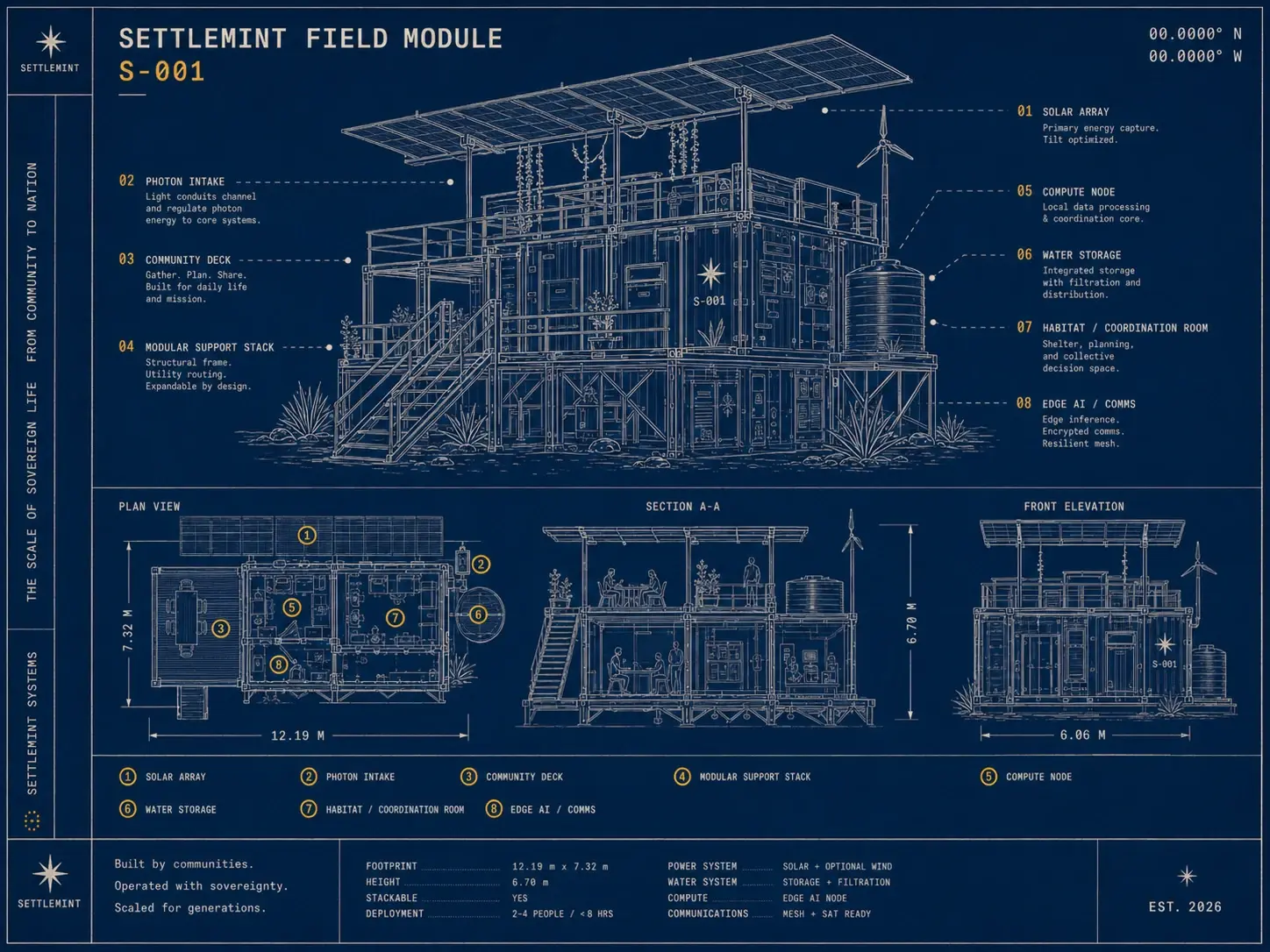
Modularity allows capability to arrive in the order the edge actually requires it.
One place may need communications first, then energy and compute. Another may begin with people, covenant, land, housing, worship, and shared work.
The system should compose around reality rather than forcing reality into one blueprint.
Local capability, networked abundance
Pure localization has limits. Pure centralization has limits.
A local community may gain resilience but lose access to scale. A centralized network may gain scale while creating brittle dependencies and concentrated control.
The emerging pattern is:
Local capability. Networked abundance.
The local node should become more capable because it participates in the network. The network should become more capable because the local node exists.
This is the same principle that appears across the architecture:
The parts remain distinct. Shared infrastructure lets them compose.
Abundance over extraction
Abundance over extraction is not a promise that economics will solve itself. It is a design test.
Extractive systems often grow by concentrating value at the center while externalizing costs to the edge.
An abundance-oriented system should ask:
- Does participation create new useful capacity?
- Does contribution strengthen the contributor as well as the network?
- Can excess become useful input somewhere else?
- Does infrastructure compound locally?
- Does value circulate back toward the places and people producing it?
- What becomes more abundant as the system succeeds?
The goal is not to eliminate profit. The question is what success produces.
If success only makes central ownership more valuable while leaving participants more dependent, the architecture has failed its own thesis.
Useful excess
Many systems produce excess that is wasted, stranded, or difficult to coordinate.
Examples may include:
- unused compute,
- excess energy,
- idle connectivity,
- spare physical capacity,
- underused equipment,
- knowledge,
- time,
- capital,
- logistics,
- or local production.
What is excess to one node may be capacity to another.
The real challenge is to make contribution measurable, trustworthy, routable, reciprocal, and worth sustaining.
Generosity and the commons
The phrase generosity is the consensus mechanism describes a social and economic thesis, not a replacement for technical consensus protocols.
It means:
A durable commonwealth can emerge when people repeatedly contribute useful capacity beyond immediate self-interest and the system makes that contribution generative rather than merely consumptive.
Generosity may include sharing excess capacity, building public goods, contributing labor, teaching, hosting, protecting, or carrying another member through failure.
But generosity cannot be coerced without becoming extraction.
A serious system must answer:
- How is contribution recognized?
- How are contributors protected?
- How are free riders handled?
- How is the commons governed?
- When should contribution create compensation, ownership, reputation, reciprocity, or no return?
A commons is not simply something free. It is a shared capability governed through rules, stewardship, maintenance, and legitimate access.
A commons without stewardship becomes depletion. A commons without meaningful access becomes private infrastructure with better language.
Earning by giving excess
Earning by giving excess points toward a possible economic pattern.
A Realm, household, or Settlemint may contribute compute, energy, connectivity, storage, hosting, logistics, physical infrastructure, or another productive resource.
The network should create value by making previously isolated capacity useful—not merely by financializing participation.
Any future mechanism must prove:
- the resource is real,
- the contribution is useful,
- demand exists,
- accounting is credible,
- compensation is sustainable,
- and the economics are not primarily speculative.
Until then, this remains a thesis rather than a proven model.
Why Realms matter at the edge
A Realm places part of the network in the hands of the person or household.
The person is not merely a consumer of the network. They may become part of its operating surface through connectivity, compute, local inference, energy, knowledge, or other contributions.
Realms are the living edge nodes of the people.
At sufficient scale, distributed Realms may extend communications, inference, resilience, geographic reach, and resource discovery.
Why Settlemints matter at the edge
Human life also requires place.
Settlemints concentrate people, infrastructure, institutions, and shared function into embodied environments.
They may allow energy systems, workshops, housing, food systems, worship, education, care, governance, logistics, and public goods to become shared rather than purely individual.
The Settlemint concentrates distributed capability into durable human function.
Why network states matter at the edge
Infrastructure alone does not answer political questions.
People eventually confront:
- who belongs,
- who decides,
- what is owed,
- what is permitted,
- how disputes are resolved,
- how common resources are governed,
- how leaders are corrected,
- and how the community relates to outside powers.
A network state is one possible answer when a network-born people develops durable political capacity, embodiment, and external standing.
Infrastructure may enable sovereignty. It should not quietly become the sovereign.
The theological foundation
Firma's Christian foundation is not decorative language applied to a neutral technical system.
It changes the underlying anthropology:
- the person is not merely a user,
- the household is not merely a consumer unit,
- the community is not merely a market,
- the land is not merely an asset,
- power is not merely control,
- wealth is not merely accumulation,
- and technology is not salvation.
The practical obligations include personhood, communion, stewardship, sacrifice, hospitality, responsibility, care for the vulnerable, and the ordering of power toward service.
The test is:
Does the system help people become more capable of faithful stewardship, mutual responsibility, and common life—or merely more efficient participants in another machine?
Sovereignty is not isolation
The language of sovereignty can become pathological when it implies withdrawal, domination, paranoia, or self-sufficiency as pride.
That is not the goal.
Sovereignty should increase the capacity to relate without being consumed.
A more capable person, community, or polity can enter relationships more freely because it has alternatives, resilience, and meaningful agency.
A precise definition of abundance
More technology, tokens, consumption, or infrastructure do not automatically create abundance.
Abundance is durable access to increasing useful capacity.
The word durable matters. Temporary provision may be relief, aid, or demonstration. It becomes abundance only when people can reliably access and sustain useful capability over time.
The lines to remember
The frontier is where systems stop being designed for what people are trying to build. The reach is where systems stop reaching the people they were meant to serve.
Local capability. Networked abundance.
What is excess to one node may be capacity to another.
The goal is not isolation. It is stronger agency, resilient dependence, and the ability to participate without being consumed.
✴ Last updated · Sun Jul 19 2026 00:00:00 GMT+0000 (Coordinated Universal Time)