✴ Part I — FoundationsCH_02
What Is a Network State?
A network state begins as a network, becomes a people, proves it can act together, acquires a physical footprint, and eventually seeks recognition as a political entity. The original formulation, the progression, and what must be proved.
A network state begins as a network, becomes a people, proves it can act together, acquires a physical footprint, and eventually seeks recognition as a political entity.
That is the shortest useful explanation.
The term is often used loosely, but the original formulation is demanding. It does not simply mean an online community with a token, a DAO that owns land, a private city, or a digital group that calls itself a country.
The concise answer
A network state is a network-born political community that develops:
- strong alignment,
- a shared founding principle,
- meaningful membership,
- collective action,
- governance,
- economic coordination,
- physical territory or settlement nodes,
- measurable scale,
- and some degree of external political recognition.
Under the original formulation, it is the final stage of a progression—not something created merely by declaration.
The original formulation
The widely cited one-sentence definition describes a network state as:
A highly aligned online community with a capacity for collective action that crowdfunds territory around the world and eventually gains diplomatic recognition from pre-existing states.
This contains four essential elements:
- A highly aligned online community
- The capacity for collective action
- A physical footprint through acquired territory
- Diplomatic recognition
Remove one of these and the project may still be significant, but under the strict original definition it has not yet become a network state.
The original progression
Startup Society → Network Union → Network Archipelago → Network State
Startup society
A startup society begins with a founding proposition strong enough to attract people who want to build a different social order around it.
The original framework emphasizes a moral innovation: a principle the group considers good that wider society may reject, or something wider society accepts that the group rejects.
The central point is that the community forms around more than an interest, product, or speculative opportunity.
Network union
A startup society becomes a network union when the community proves it can coordinate digitally and act collectively.
This is a major threshold. Many communities can discuss ideas. Far fewer can:
- make decisions,
- pool resources,
- complete projects,
- establish norms,
- maintain membership boundaries,
- and sustain action over time.
A network union is where shared belief becomes organized capacity.
Network archipelago
A network union becomes a network archipelago when it develops a distributed physical footprint.
The community may acquire or coordinate:
- homes,
- offices,
- gathering spaces,
- farms,
- campuses,
- businesses,
- neighborhoods,
- or other physical nodes.
These places do not need to be contiguous. Their unity comes from the network, shared institutions, membership, and governance.
Network state
In the strict original model, the network archipelago becomes a network state when it gains some measure of diplomatic recognition from an existing government.
The essential sequence is:
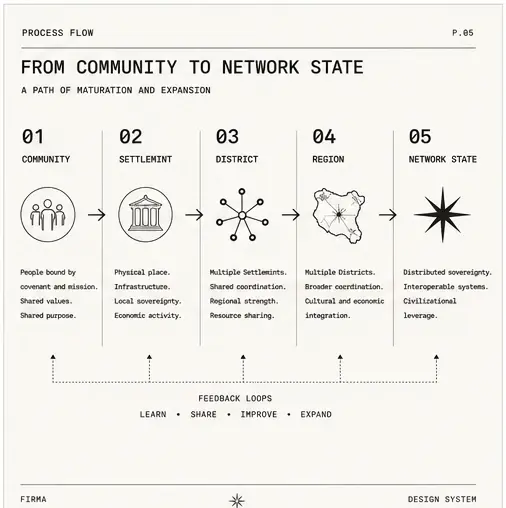
We believe together → we act together → we inhabit places together → others begin to recognize us politically.
What the concept gets right
It begins with people before territory
The network-state model does not begin by declaring sovereignty over land and attempting to manufacture a people afterward.
It begins with:
people → alignment → collective action → physical presence → recognition
It distinguishes attention from collective action
Followers, subscribers, and token holders are not the same as a people capable of acting together.
A credible network polity must demonstrate execution, not merely reach.
It requires physical embodiment
The mature network state is not purely digital.
People still require:
- housing,
- food,
- energy,
- work,
- infrastructure,
- care,
- worship,
- safety,
- and places to gather.
A network can coordinate people across distance, but civilization must eventually function somewhere.
It treats national consciousness seriously
A network state is more than a platform or financial network. Its members must develop enough shared identity to think in terms of we.
It recognizes that the outside world matters
Self-declaration does not create statehood. A flag, constitution, token, or website may express political aspiration, but external standing must be earned.
What a network state must prove
For this guide, the major proofs can be grouped into eight categories.
1. A people
Not merely users, customers, investors, or followers, but a body of people with a durable shared identity.
2. A binding principle
The community needs a reason to exist beyond convenience or financial upside.
The original framework calls this a moral innovation. Other communities may form around covenant, religion, civilizational identity, shared place, or another binding proposition.
3. Collective action
The members can make decisions and execute together.
4. Governance
The community has legitimate decision rights, accountability, dispute resolution, and continuity.
5. Economic capacity
It can coordinate resources, production, exchange, treasury activity, or public goods.
6. Physical embodiment
The community has real places, real operations, and consequences beyond the internet.
7. Verifiable scale
Its claims about membership, participation, economy, and physical footprint can be demonstrated rather than merely asserted.
8. External standing
Governments, institutions, neighboring communities, and other political actors increasingly treat the community as a real entity with which they can interact.
What does not prove a network state
A large following does not prove a nation.
A Discord does not prove a polity.
A token does not prove an economy.
A DAO vote does not prove governance.
Land ownership does not prove sovereignty.
A flag does not prove legitimacy.
A constitution does not prove enforceable law.
A meeting with government officials does not prove diplomatic recognition.
A blockchain does not prove statehood.
These things may contribute to a larger system. None is sufficient by itself.
Does a network state need land?
Not at the beginning. Yes in the mature original model.
A startup society may begin entirely online. A network union remains primarily digital. The network archipelago stage, however, requires a physical footprint.
The mature network state is therefore not simply a digital nation.
Must its territory be contiguous?
No.
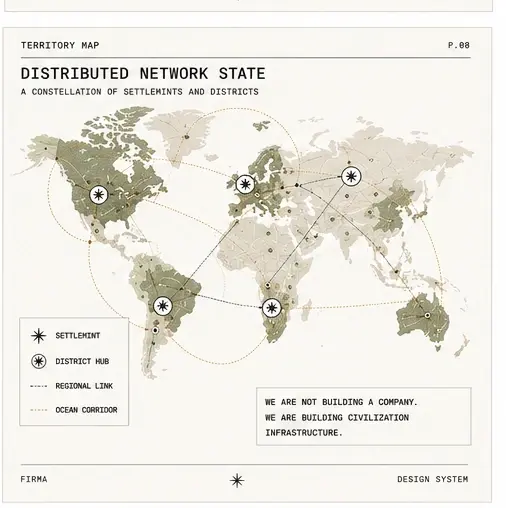
This is one of the model's defining departures from the traditional territorial state. A network state may consist of geographically distributed nodes connected by shared membership, governance, identity, and digital infrastructure.
Does it need sovereignty?
That depends on how the word is being used.
The original framework requires state-like political development and some measure of diplomatic recognition. It does not necessarily mean that every network state immediately possesses full sovereign equality under international law.
The clean distinction is:
Network-state maturity, practical state capacity, and full sovereign statehood are related but separate thresholds.
Does it require diplomatic recognition?
Under the strict original formulation: yes.
That is the final distinction between a network archipelago and a network state.
However, recognition must be handled carefully. An introduction to a mayor, an MOU with a ministry, municipal cooperation, recognition by a sovereign government, formal diplomatic relations, and membership in an international organization do not carry equal weight.
The guide will treat recognition as a spectrum of external standing rather than one vague claim.
Strict definition and broader usage
The term network state is now often used more broadly than the original formulation.
Contemporary projects may use it to describe:
- startup societies,
- digitally coordinated nations,
- network unions,
- network archipelagos,
- private cities,
- intentional communities,
- charter-city projects,
- online-first political movements,
- or early network polities.
This guide will not pretend that language has remained perfectly fixed. It will distinguish among:
- the original network-state definition,
- broader contemporary usage,
- network polity,
- state-like capacity,
- and formal sovereign statehood.
Network state versus network polity
A network polity is a digitally coordinated political community with meaningful membership, governance, collective action, and shared institutions.
It may exist without territory, diplomatic recognition, or full statehood.
This term is useful because it allows us to describe something politically real without granting it a status it has not yet earned.
Network states and Settlemints
The two concepts answer different questions.
The network-state framework asks:
How can a network-born community become a people, act together, acquire territory, and gain political standing?
The Settlemint framework asks:
How does a place become capable of sustaining human life, governance, production, infrastructure, memory, care, and belonging?
The relationship is not competitive.
A network state is a theory of political emergence. A Settlemint is a theory of settlement maturity.
A network state may contain one Settlemint or many. A Settlemint may support a network state, another polity, an existing government, a religious community, or a humanitarian deployment. A Settlemint may never seek statehood at all.
The goal is not to replace the network state. It is to give it somewhere to live.
✴ Last updated · Sat Jul 18 2026 00:00:00 GMT+0000 (Coordinated Universal Time)