✴ The Frontier Standard · SpecificationsST_06
Dispute and Appeals Protocols
The questions every dispute-resolution arrangement must answer — not the arrangement itself.
This specification standardizes the questions a Settlemint's dispute-resolution and appeals arrangement must be able to answer. It does not prescribe the arrangement. It names no courts, panels, arbitrators, or appeal chains — a community designs those. What it standardizes is the discipline that keeps a dispute process honest about its own authority.
Status: Working specification v1 — the required questions are published canon; the bodies, procedures, and sanctions that answer them are each community's to design, and several remain open questions in the canon.
The operational treatment is published in the handbook at Governance and Dispute Resolution; the sovereignty and jurisdiction doctrine behind it is at What Is Sovereignty?.
1. The required function
Resolving disputes is one of the minimum functions of governance. A community that cannot resolve conflict has not proved governance, only leadership — and the test is not whether it works in agreement but whether it works in disagreement:
Does it work when people disagree?
A dispute process is proved the same way every function is: by working repeatedly, under strain.
Continuity is repeated function under changing conditions.
2. The standard questions
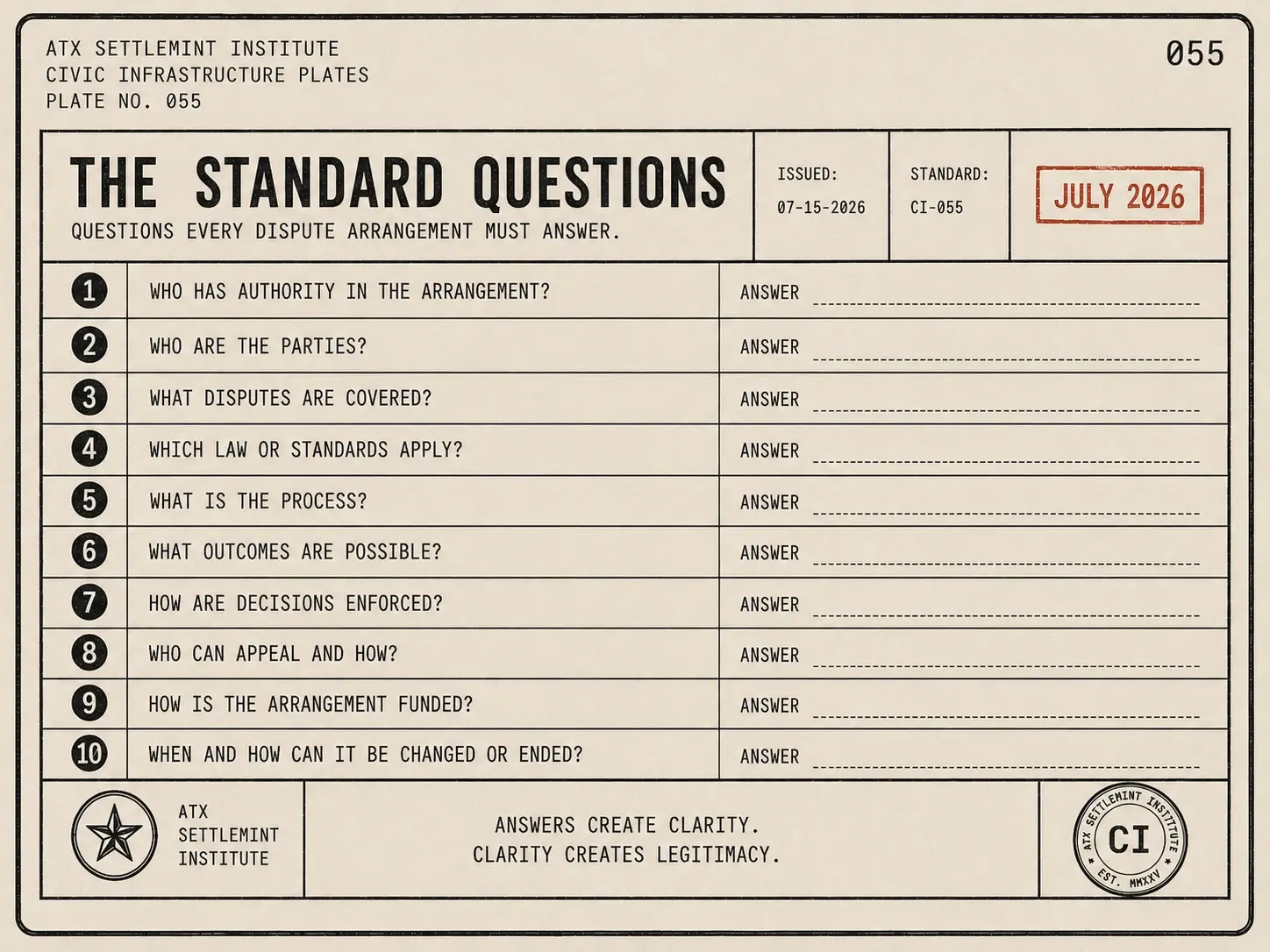
Before a Settlemint claims a dispute-resolution arrangement, it must be able to answer:
- Who resolves the dispute? — which role or body has the recognized right to decide.
- Under what authority? — the source of that right, and its limits.
- Can a decision be appealed or challenged? This is a required profile question: can people leave, appeal, or challenge decisions?
- Who has the final appeal? — the point beyond which there is no further internal recourse.
- Who can override the decision — and can the community's own process be overridden from outside it?
- Can a party exit? — and what exit costs or preserves.
These are questions, not a procedure. A conformant arrangement has practiced answers; it does not have a mandated institution.
3. The jurisdictional boundary
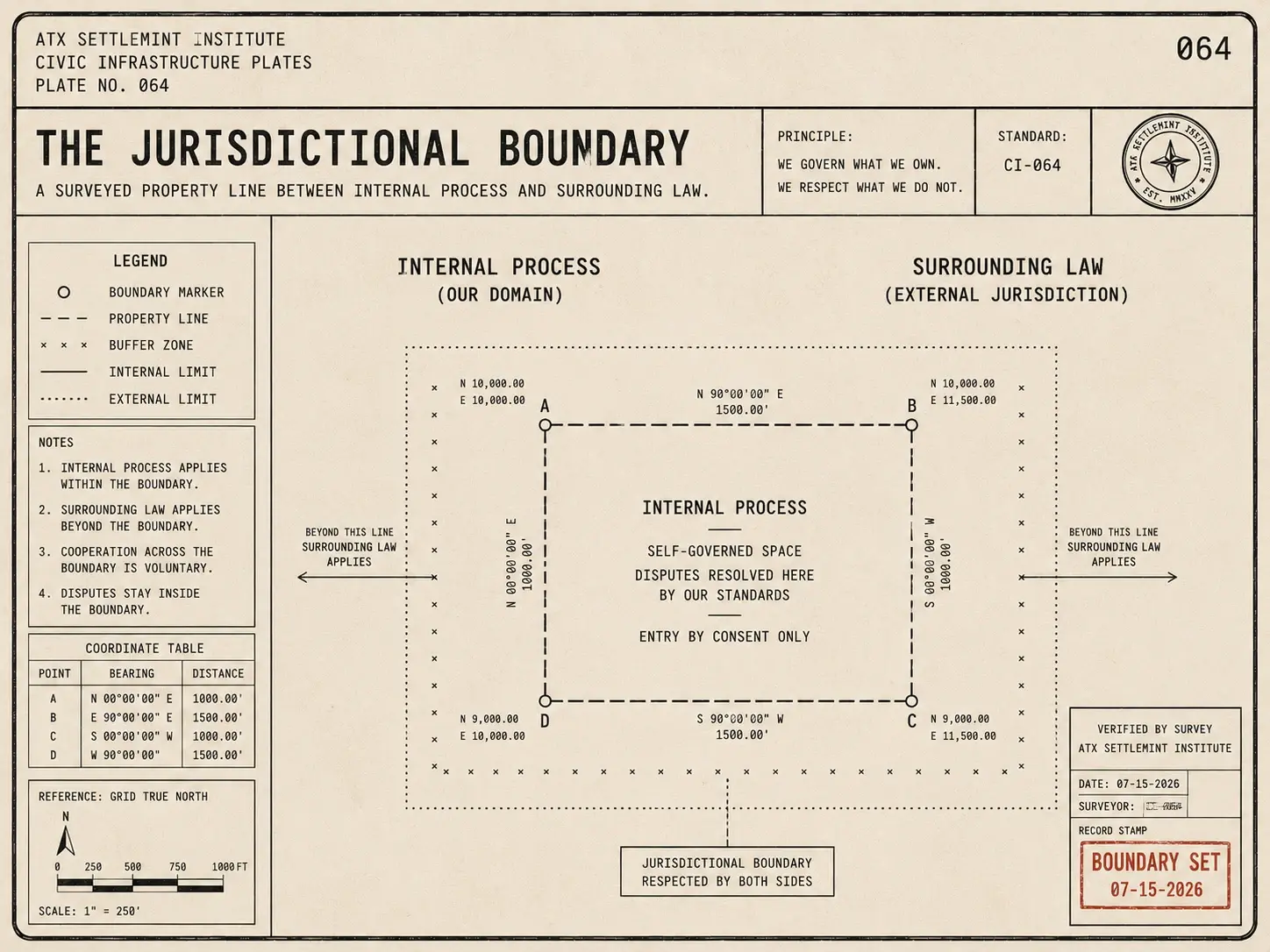
A dispute-resolution arrangement must be honest about the authority it actually holds, which is usually narrower than it feels. Internal resolution operates within the surrounding sovereign's law, not above it.
A community may have contractual authority over property use without possessing criminal jurisdiction over residents.
A Settlemint may resolve a work dispute, a membership dispute, or a resource dispute through its own accepted process. It does not thereby acquire authority over matters the surrounding state reserves — criminal law, and the ultimate coercive enforcement behind any ruling. A conformant arrangement names that boundary rather than blurring it. The full instrument for describing where authority actually lies is Sovereignty and Autonomy Vectors.
4. The memory requirement
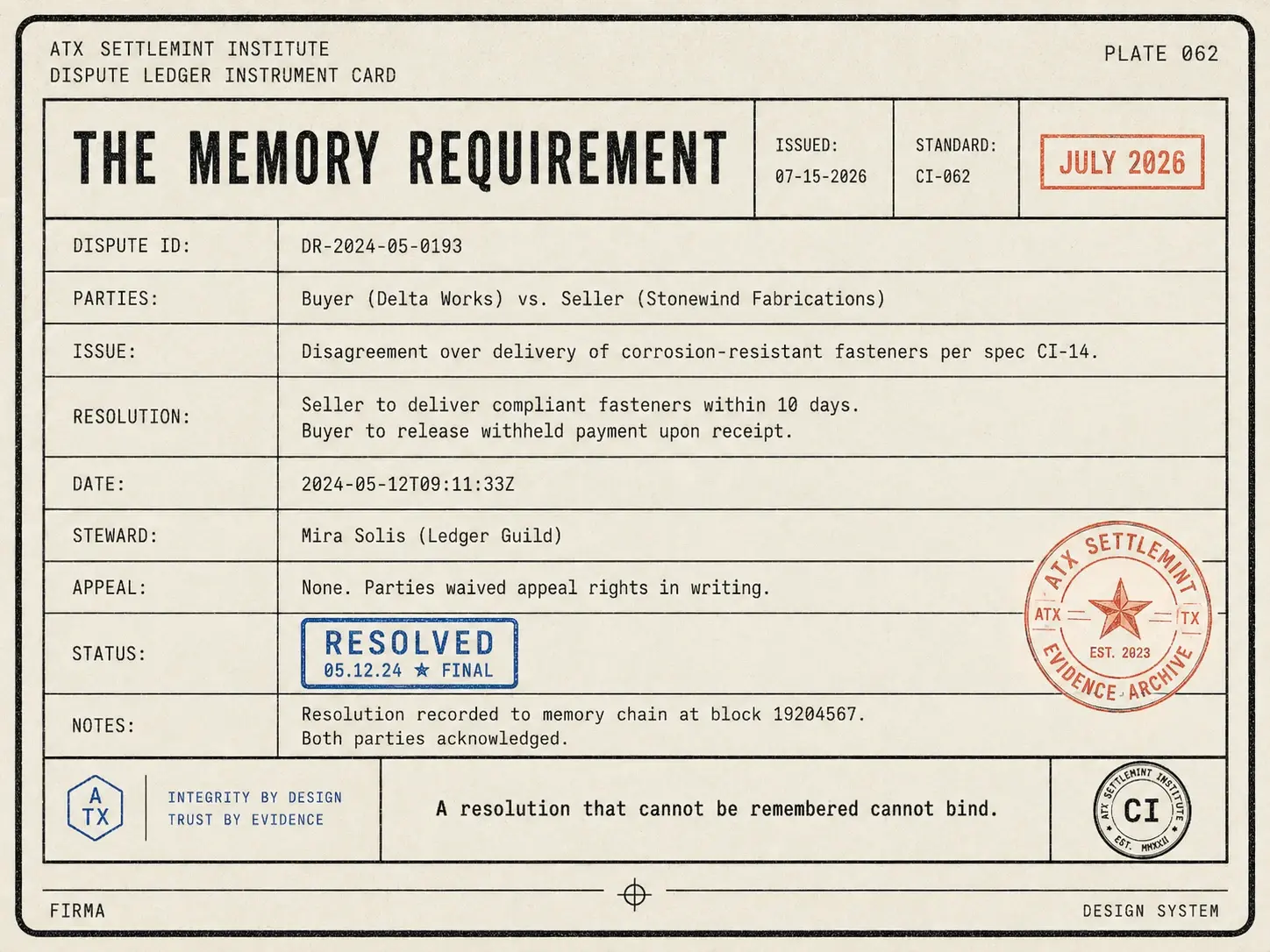
A dispute that is resolved and then forgotten has not built anything. The settlement must be able to remember how disputes were resolved — the decision, its basis, and its outcome — so that resolution accumulates into precedent and accountability rather than resetting with every conflict.
5. Conformance
A dispute-resolution and appeals arrangement conforms when it:
- Can actually resolve conflict — demonstrated repeatedly, including under strain, not only in agreement.
- Answers all of the standard questions with practices the community actually follows.
- Provides a genuine path to appeal or challenge, and names who holds the final appeal.
- States honestly the external jurisdiction above it — what the surrounding sovereign reserves and can override.
- Records how disputes were resolved, so resolution accumulates.
6. What this specification does not define
This specification defines no bodies, procedures, appeal chains, or sanctions. Entry, discipline, removal, appeal, and exit remain open — they are named open questions in the canon, each community's to answer. This specification requires that a dispute process exist, be practiced, and be honest about its authority; it does not prescribe the court that carries it.
✴ Last updated · Sun Jul 26 2026 00:00:00 GMT+0000 (Coordinated Universal Time)