✴ The Firma Architecture · ComponentsAR_07
THEOS
The agentic operating system — the software layer that helps an organization stay aligned with its own governing intent without replacing human judgment, and gives every Settlemint its own private, sharded instance rather than one central mind.
The function comes first
An organization that grows past a certain size stops being able to hold itself in one person's head. Decisions accumulate, language shifts, spending moves, projects drift from the purpose that once justified them — usually without anyone deciding to let it happen. The function THEOS names is an organizational memory and alignment layer: something that watches the organization's own operational reality and helps it notice when it is drifting from what it said it would be, while leaving every actual judgment to people.
The canon states the whole system's premise first, because THEOS only makes sense underneath it:
People are sovereign. Settlements are real. Organizations have constitutions. Software exists to serve them—not replace them.
The named implementation
THEOS is the Agentic Operating System.
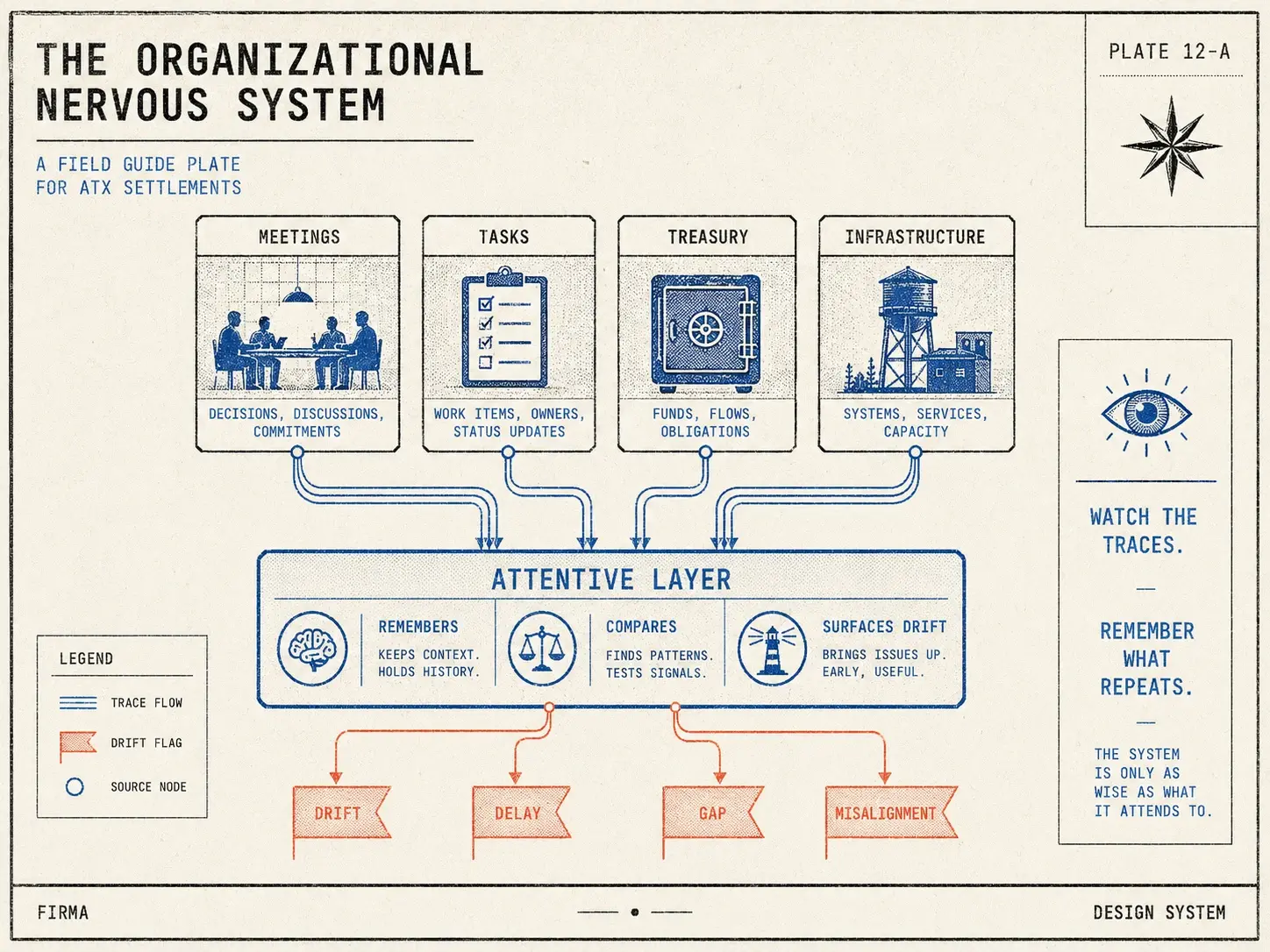
It is the working environment for builders, leaders, and team members inside an organization — where agents, workflows, documents, and institutional memory come together. It "functions as the organizational nervous system": it orchestrates agents, coordinates workflows, preserves institutional memory, maintains context across the organization, and reasons over that context to assist the people doing the work.
Against the organization's own constitution and governing principles — expressed as an alignment framework it can evaluate against (the DNA Protocol) — THEOS continuously compares what the organization is actually doing to what it committed to be.
Maturity: proposed. THEOS begins as the operating system for builders and teams inside Firma and affiliated organizations, and is intended to extend outward from there. No source establishes it as fully deployed, operational, or proven; it is named with a function and an owner.
Constitutional intelligence, not authority
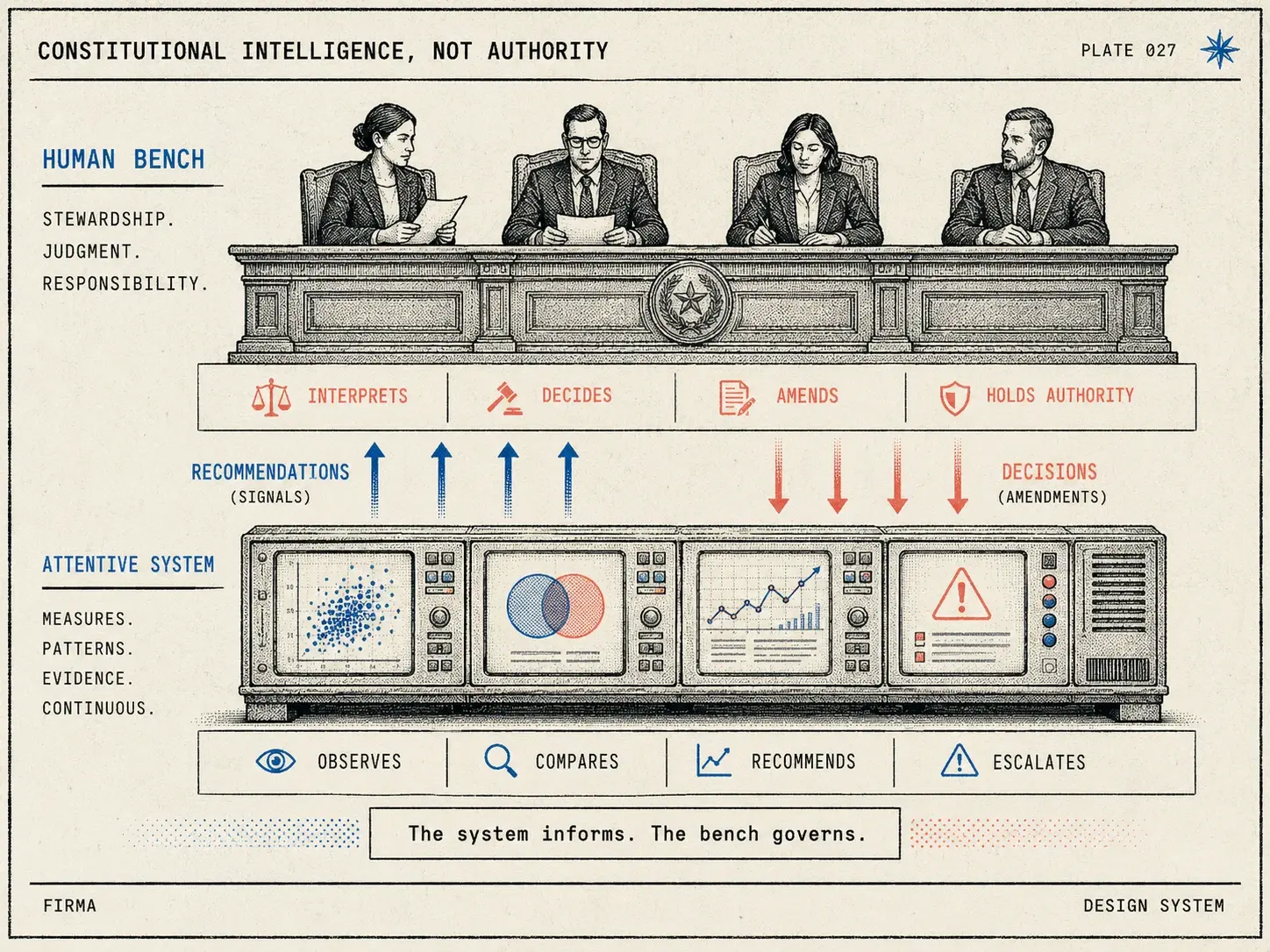
This is the boundary the whole component depends on. THEOS may observe, compare, analyze, recommend, explain, document, and escalate. It may notice that an action seems to exceed delegated authority, that a definition has quietly changed meaning, that spending no longer matches stated priorities. But it decides nothing.
THEOS acts as constitutional intelligence. Not constitutional authority.
Only people interpret constitutional principles, resolve disagreements, approve exceptions, amend governing documents, and assign or remove authority. The line is exact:
THEOS may detect a breach. Only legitimate governance may adjudicate it.
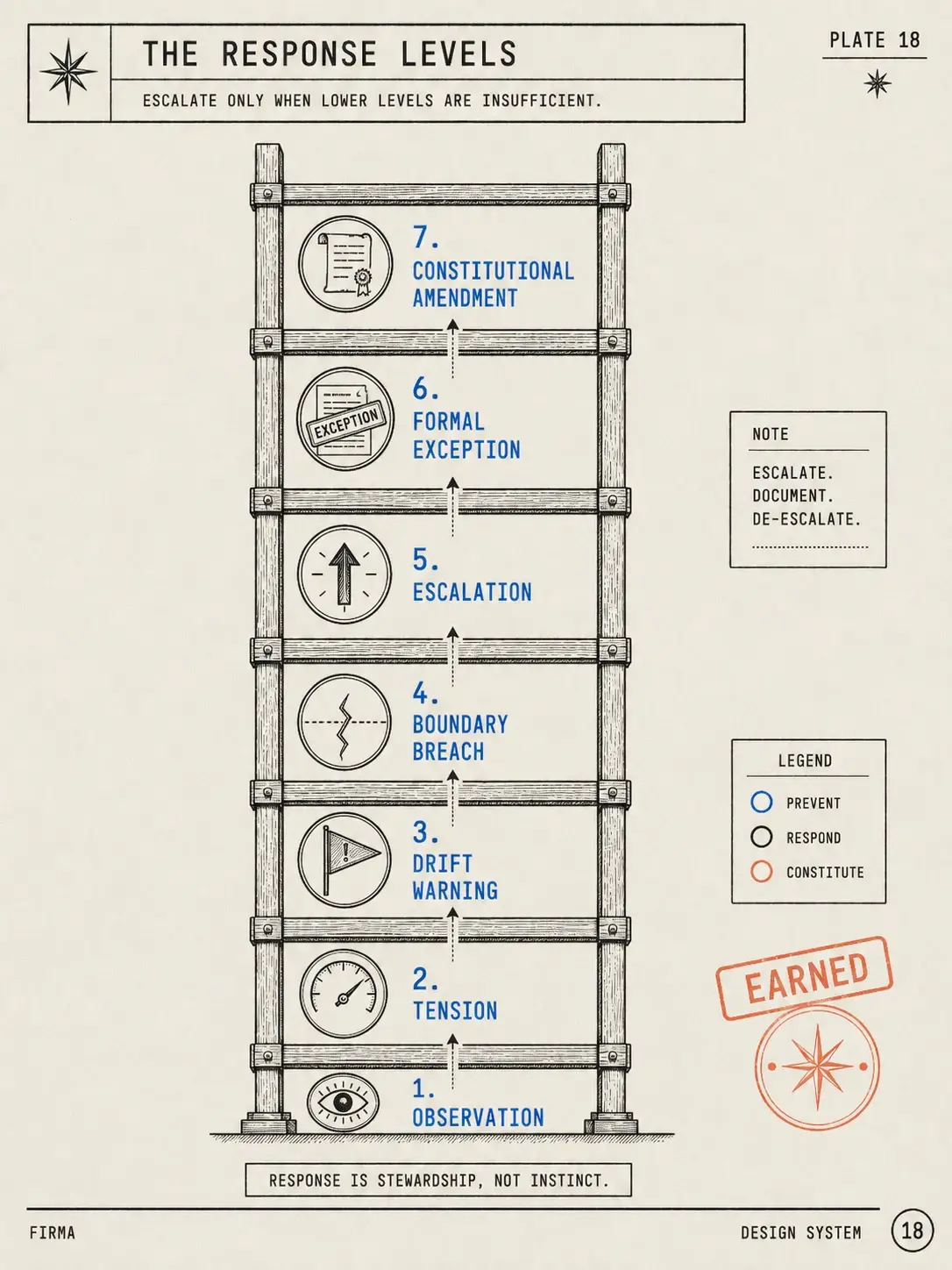
And it is built to be measured, not alarmist. It watches categories of drift — vision, governance, language, financial, cultural, execution, and others — and responds in graduated levels, from a quiet observation, through tension and a drift warning, up to escalation and, at the far end, a formal exception or constitutional amendment that only human governance can authorize. Most of what it sees is an observation, not a crisis.
THEOS helps governance remain aligned. It does not replace governance.
Every settlement runs its own shard
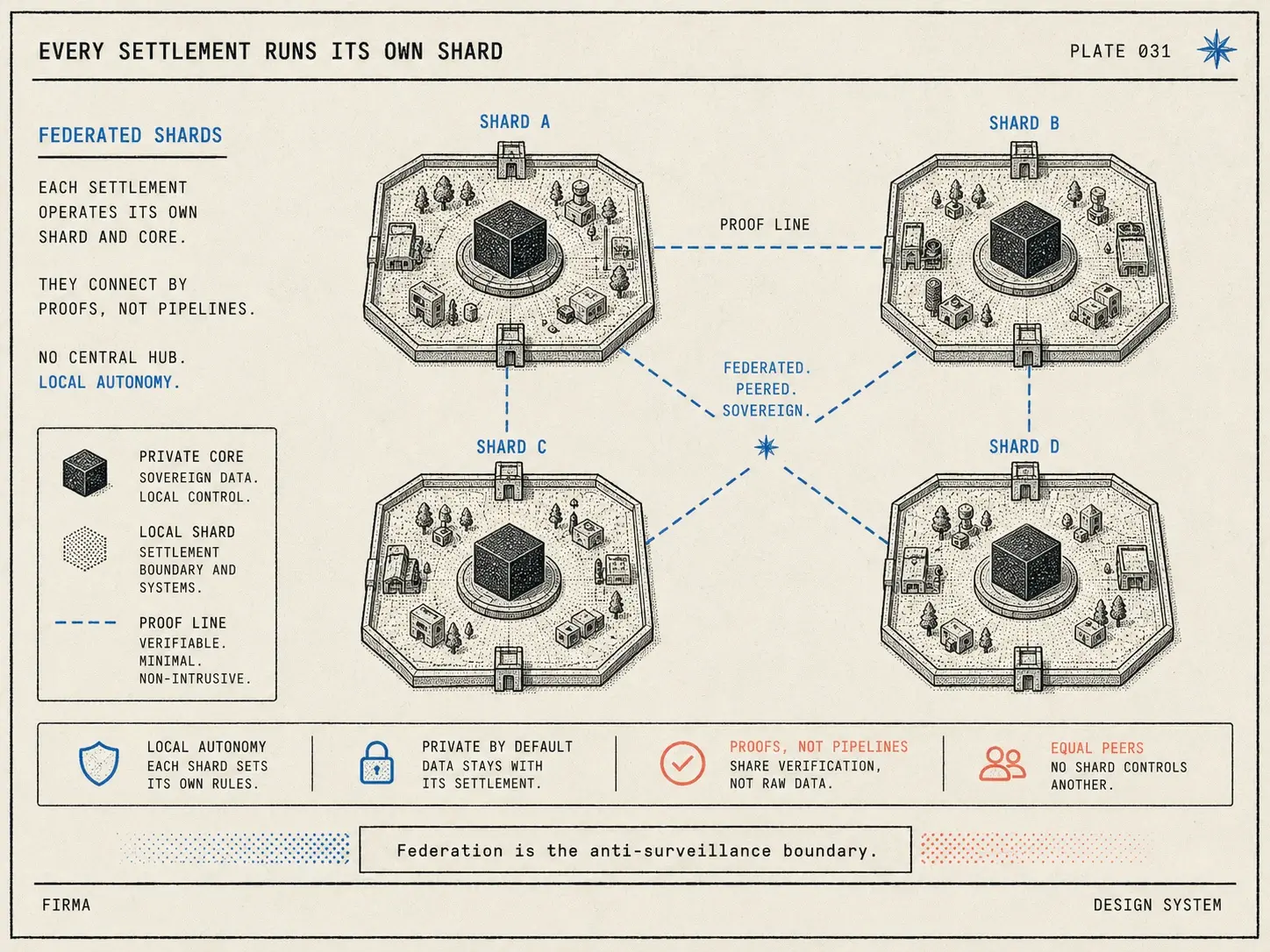
THEOS is deliberately not one central mind watching everyone. Each Settlemint eventually operates its own THEOS shard — a local instance that develops deep understanding of its own community: its members, missions, governance, contributions, and institutional memory.
Crucially, that understanding stays home:
That understanding remains private unless intentionally published.
The intelligence is federated, not pooled. A shard's knowledge of its own settlement belongs to the settlement, not the network — which is precisely what keeps an alignment layer from turning into a surveillance layer. Each Settlemint needs its own shard for the same reason it needs its own governance: the understanding of a place should live in that place.
The privacy boundary
THEOS observes the operational traces of an organization, which is exactly why its restraint matters. Those traces — conversations, deliberations, internal reviews, pastoral context, sensitive telemetry, personal AI context — do not automatically become network-wide knowledge. Each shard keeps its own private operational intelligence, and every data domain defines what may be shared, along a spectrum from private-to-the-person up to public.
Publication should always be intentional. Not automatic.
What crosses to the shared substrate (Firmamint) is only the verified, minimal signal the wider network needs — a proven credential, a completed commitment, an approved result — never the raw internal life behind it. Realm remains the person's own domain throughout: THEOS interacts with a Realm; it does not own one.
What remains open
How shards federate, how the alignment framework is authored and versioned, how drift signals are tuned so they inform rather than nag, and exactly where each publication boundary falls, all remain to be designed and proven. Those are implementation.
The function is canonical. The implementation is provisional.
✴ Last updated · Sun Jul 26 2026 00:00:00 GMT+0000 (Coordinated Universal Time)