✴ The Firma Architecture · ComponentsAR_02
Firmamint
Firmamint is the proposed shared substrate through which distinct people, Realms, Settlemints, Districts, and political communities may coordinate, remember, exchange, compute, prove, and interoperate.
Firmamint
Firmamint is the proposed shared substrate through which distinct people, Realms, Settlemints, Districts, and political communities may coordinate, remember, exchange, compute, prove, and interoperate.
Stated more fully:
Firmamint is the shared substrate through which Realms, Settlemints, and network states can coordinate, remember, exchange, compute, prove, and interoperate without collapsing into one centralized system.
The key word is substrate. A substrate is the underlying layer on or through which something else can exist, grow, coordinate, or operate. Firmamint is not the person. It is not the Realm. It is not the settlement. It is not the state. It is the underlying coordination layer that can make those distinct things legible to one another and capable of operating as parts of a greater whole.
The composition line:
Realm is the personal edge.
Settlemint is the embodied place.
Network state is the political community.
Firmamint is the substrate beneath the whole.
And in expanded form:
Realms are the living edge nodes of the people. Settlemints are the embodied places they make operable. Network states are the political communities they may compose. Firmamint is the substrate through which they coordinate, remember, exchange, compute, prove, and interoperate.
Where Firmamint fits in the broader civil and political map is introduced in Where Firma Fits; this page describes the component itself.
Substrate, not sovereign
The most important boundary:
Firmamint is not the Realm, the Settlemint, or the network state.
It is the shared substrate through which they may coordinate and become legible to one another. This matters because architecture can easily drift into treating software objects as if they prove human or political realities. A protocol object does not prove a functioning Realm. A software representation does not prove a Settlemint. A protocol milestone does not prove network statehood. The substrate may record, connect, or help prove parts of reality. It does not create reality merely by naming it.
Firmamint is not a company, government, city, settlement, nation, or network state. It is orthogonal to the civil architecture — it may operate across several layers rather than sitting above them as another political tier.
Firmamint runs through the architecture; it does not sit above it as sovereign ruler.
This preserves an essential boundary:
Infrastructure may enable sovereignty. Infrastructure should not quietly become the sovereign.
And its corollary from the conceptual volume:
Shared substrate is not the same as centralized rule.
Firmamint does not itself create legitimacy, sovereignty, diplomatic recognition, or statehood. Those must be proven politically, legally, socially, and institutionally.
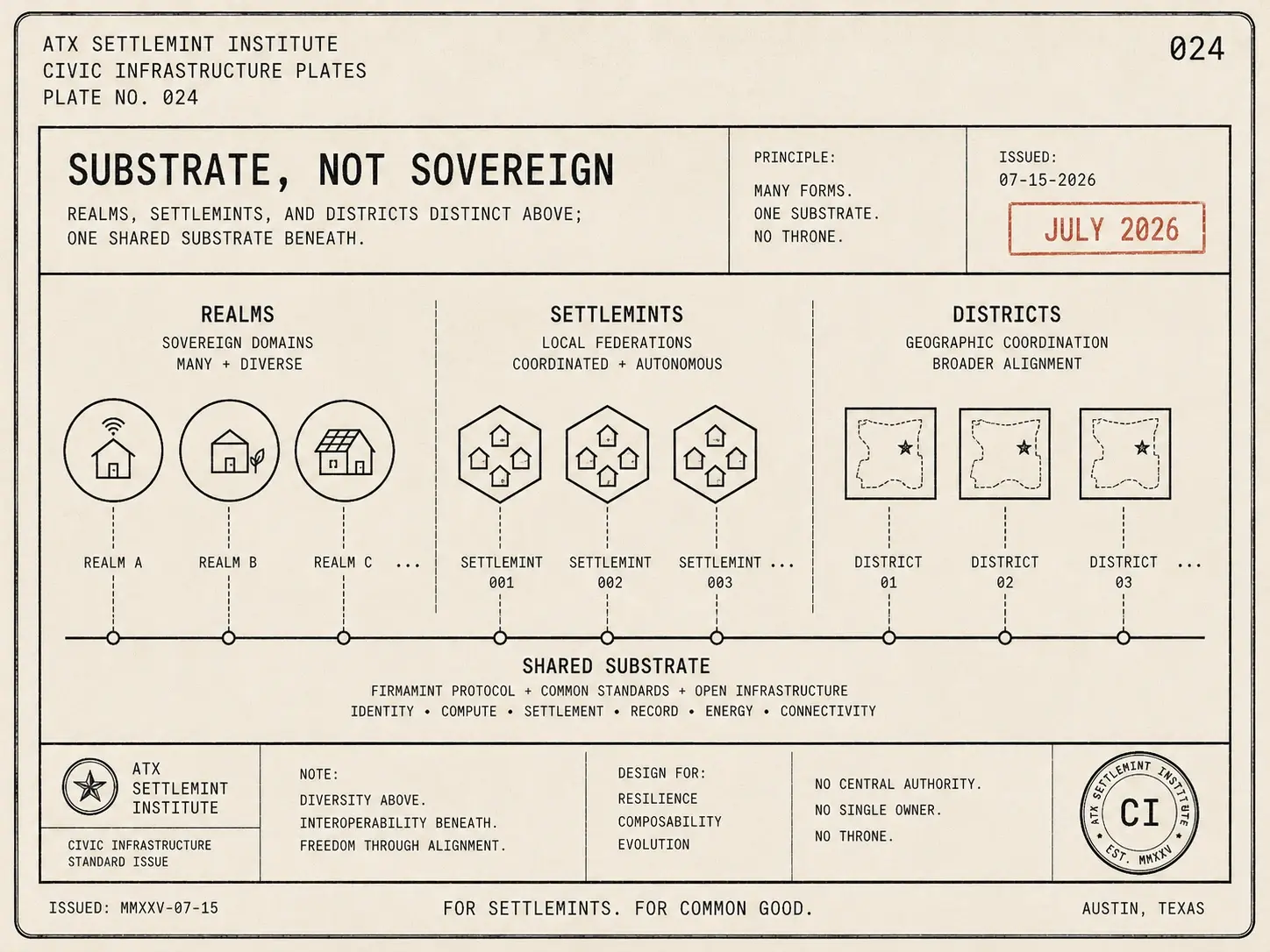
What Firmamint may coordinate
Proposed. At the architectural level, Firmamint may eventually support:
- identity and permissions,
- contribution memory,
- ownership records,
- reputation and participation history,
- economic rails,
- agent coordination,
- compute access,
- settlement proofs,
- interoperability,
- shared records,
- routing of value or work,
- and forms of finality or persistent state.
These are possible functions of the substrate. None of them should be treated as deployed or fully defined.
A further boundary governs what the substrate should hold. Firmamint is not organizational memory:
Firmamint should not receive raw organizational memory.
Firmamint receives only what the network needs to verify or coordinate — examples include settlement records, resource commitments, compute and energy availability, portable credentials, attestations, verified capabilities, contribution proofs, governance proofs, and inter-settlement coordination. The internal life of a person, household, organization, or settlement — conversations, deliberations, private context, telemetry — stays private to its own domain. Publication to the substrate should always be intentional, not automatic. Proposed — the exact publication-boundary model remains open.
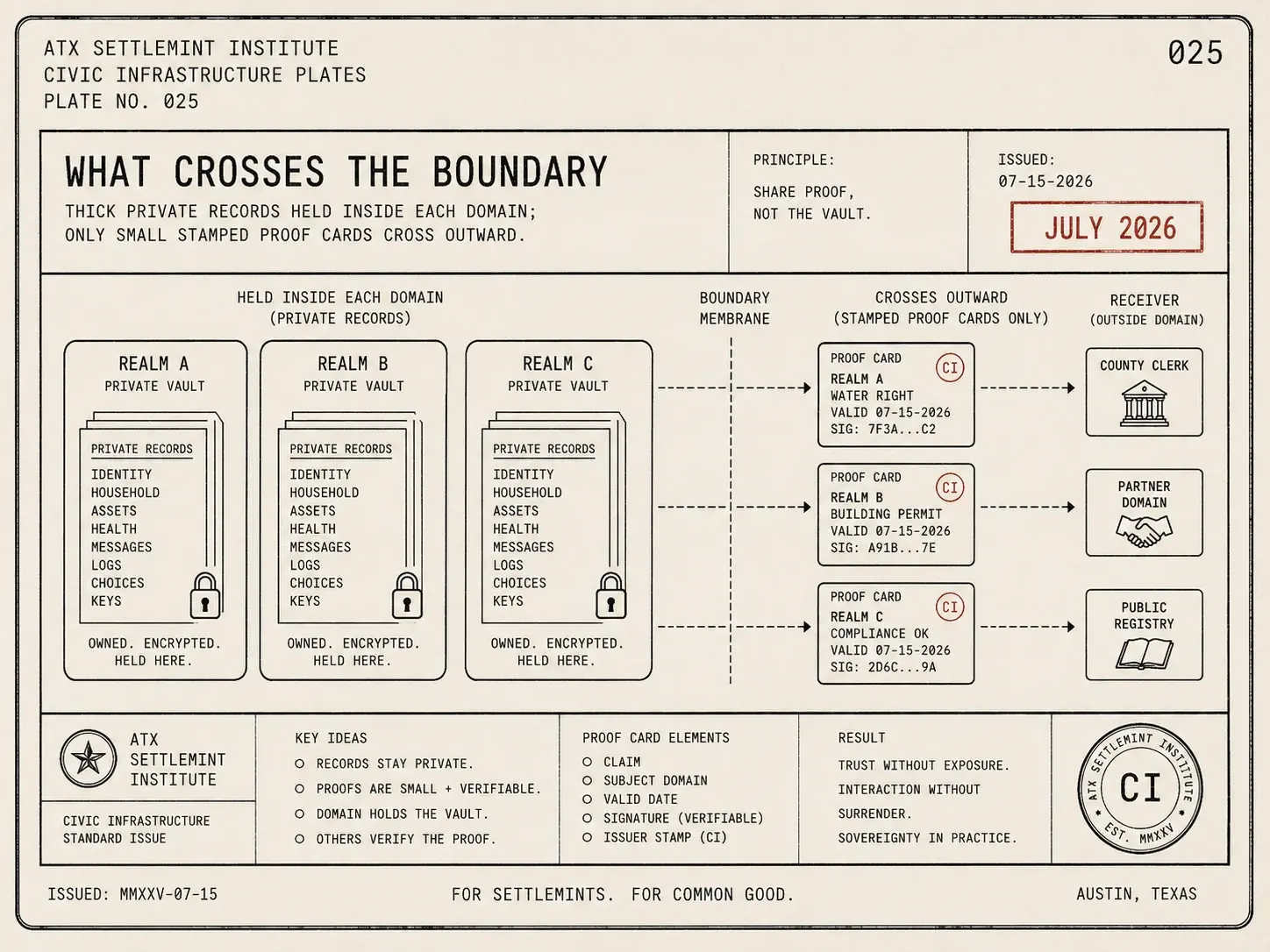
Firmamint and the other components
Firmamint and Realm. Proposed. Firmamint may give a Realm a way to persist across devices, remember contribution, coordinate agents, prove participation, access shared compute, exchange value, interoperate with other Realms, and connect into broader settlement and network systems. The Realm remains the person's domain. Firmamint is the substrate that helps that domain participate in the larger whole.
Firmamint and Settlemints. Proposed. Firmamint may help a settlement coordinate people, permissions, work, contribution, resources, treasury activity, infrastructure participation, identity, memory, and interoperability with other Settlemints. But:
The Settlemint is the human settlement. Firmamint is part of the substrate that may help it remember, coordinate, and interoperate.
The digital representation must not be confused with the place itself.
Firmamint and network states. Proposed. Firmamint may help provide shared infrastructure for membership, identity, coordination, proof, economic activity, distributed operations, relations among physical nodes, and interoperability with other network states — while legitimacy remains a political, legal, social, and institutional matter.
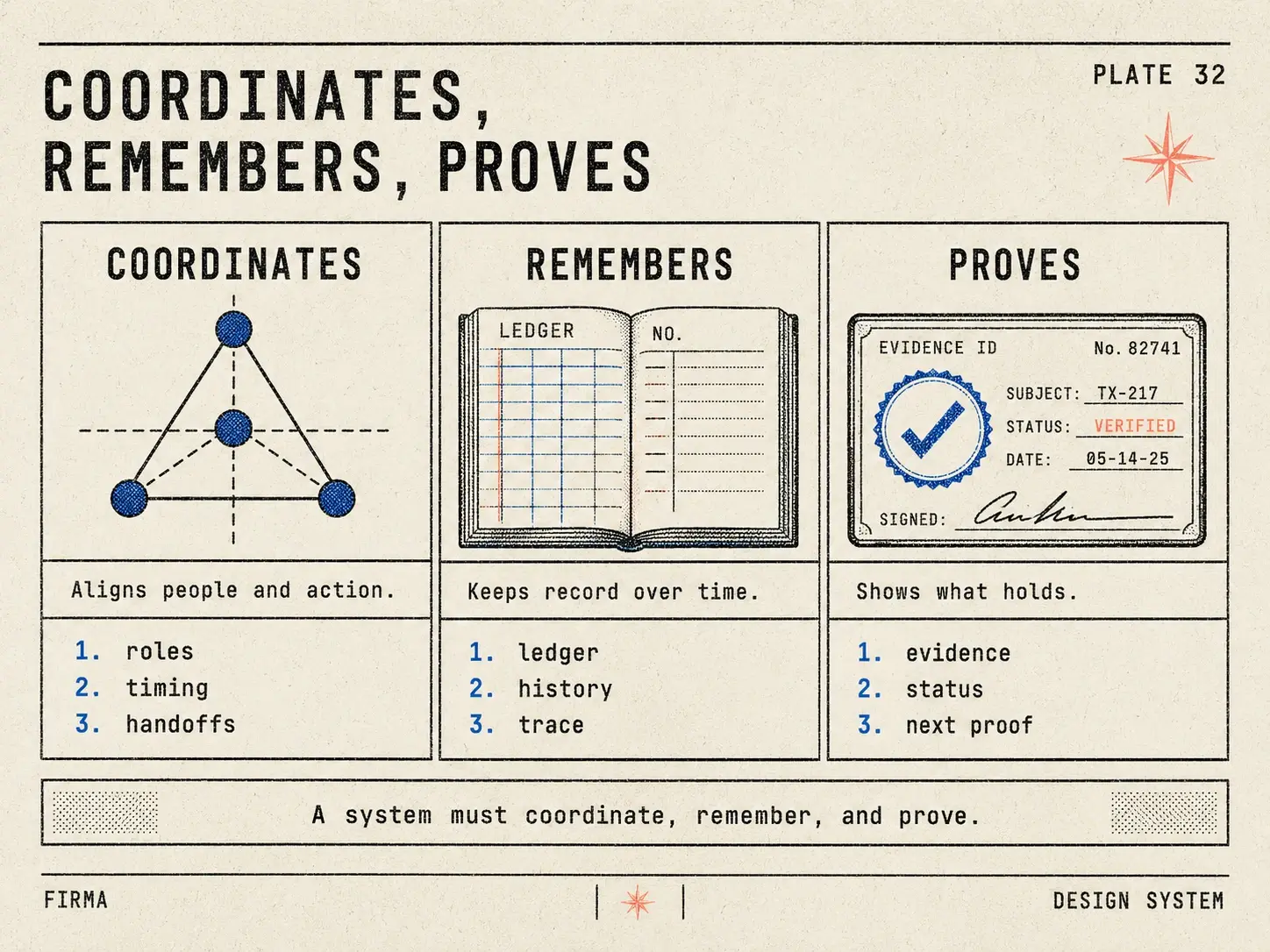
Placement in the organizational architecture
Firmamint is a protocol developed and technically stewarded by Firma Labs, the operating division responsible for technology, infrastructure, and engineering. Governance of the protocol is designated to sit with Protocol Governance under the Firma Foundation: the divisions build and operate the protocols; Protocol Governance defines what they must honor.
Firmamint is the foundational protocol of the Settlemint Stack, the integrated protocol stack combining the modular protocols required for a functioning settlement:
- Firmamint — foundational network, coordination, and interoperability protocol
- Governmint — governance and jurisdiction launchpad
- Embodimint — human identity and participation protocol
- Elemint — digital representation of real-world assets
- Figmint — economic and monetary coordination protocol
- Atonemint — protocol of reconciliation
- Testamint — sacred protocol layer, governed within Theosis and engineered by Labs
The other six protocols of the stack are designed to run on Firmamint as their protocol infrastructure. And Firmamint may serve every division — Capital, Labs, and Theosis alike:
Firmamint can serve the whole ecosystem without governing the whole ecosystem. A shared protocol may support the order without becoming the authority over the order.
That is the organizational expression of substrate, not sovereign.
Maturity
Firmamint remains an emerging substrate architecture. The architectural role described on this page — the substrate category, its boundaries, and its relationships to Realm, Settlemint, and network state — is settled. The capabilities themselves remain proposed: none should be read as deployed or operational without separate evidence. Per the governing rule of this volume:
The function is canonical. The implementation is provisional.
Firmamint and emergence
Realm creates the conditions for emergence by connecting stewarded personal domains. Settlemints concentrate that emergence into functioning places. Network states may organize those people politically. Firmamint can provide the substrate that lets these systems remain connected without forcing them into one centralized authority. That leads to a deeper principle:
The parts remain distinct. The substrate lets them compose.
That may be one of the most important architectural ideas in the whole system.
What remains open
These require separate proof and design:
- the underlying chain architecture and finality model,
- how Realms and Settlemints are represented in substrate state,
- exact identity primitives,
- the exact contribution ledger,
- the exact reputation model,
- the exact settlement proof model,
- exact compute routing,
- exact agent-payment architecture,
- the exact publication-boundary model,
- and the exact relationship to the other protocols and modules of the stack.
Related: Realm · Where Firma Fits
✴ Last updated · Tue Jul 21 2026 00:00:00 GMT+0000 (Coordinated Universal Time)